
A smoother financial roadshow starts with transportation planned around the itinerary, not a string of disconnected rides. Planning roadshow transportation for financial firms means coordinating the executive, vehicle, and meeting sequence as appointment times shift and stops fill the schedule. Even a well-prepared day can feel pressured when there’s little room for delays.
Comfort, discretion, and cost all matter, but so does the booking structure. An hourly chauffeured booking provides a dedicated vehicle and professional driver for the booked time, making it a natural fit for a multi-stop itinerary. Choose a sedan or SUV based on the number of passengers and their luggage, rather than appearance alone.
This 2026 buying guide explains how to assess chauffeur service, vehicle fit, scheduling details, and booking structure so the traveler and coordinator have a clear plan. Use the steps below to shape the itinerary and make each transfer support the day’s meetings with greater control and less travel friction.
Key Takeaways
- Plan roadshow transportation for financial firms around the full meeting sequence, with clear pickup windows and transition time between stops.
- Gather addresses, expected meeting durations, passenger details, and luggage needs before selecting a service structure.
- Compare hourly bookings, separate point-to-point rides, and a mixed itinerary by how each handles schedule changes and organizer coordination.
- Choose a sedan or SUV to suit the traveler and luggage, then share concise pickup instructions and a clear process for communicating updates.
- Align the booking details with the itinerary so the executive, chauffeur, and coordinator have a composed plan for the travel day.
Why roadshow transportation for financial firms needs itinerary-first planning
Several meetings, a fixed agenda, and short windows between appointments leave little room for avoidable transport friction. A roadshow is more than a list of addresses: the order of stops, expected meeting lengths, and pickup timing all shape how the day unfolds. That’s why roadshow transportation for financial firms should be planned around the itinerary, not pieced together as unrelated rides.
Roadshow transportation is pre-coordinated chauffeured travel between scheduled meetings, organized around the day’s sequence, timing, and passenger needs. For roadshows connected to an Initial Public Offering (IPO), transport is one practical part of a broader, meeting-led schedule. Keeping one vehicle and chauffeur for the booked time can simplify transitions between appointments and reduce the organizer’s need to arrange a new pickup for every leg.
What makes a financial roadshow different from routine corporate travel?
A single airport transfer has a clear start and destination; an ordinary business trip may involve one appointment and open time around it. A roadshow, by contrast, can require several consecutive stops, each tied to a meeting on a fixed agenda. If one conversation runs long, the next transition may become harder to manage. Planning each leg as part of the full sequence helps the organizer account for pickup windows, travel time, and meeting duration instead of treating every ride in isolation.
Which transportation priorities matter most to executives?
Punctuality and a composed journey go hand in hand. A professional chauffeur and calm vehicle environment give an executive space to transition between meetings, while a suitable sedan or SUV can meet passenger comfort and luggage needs. Discretion is also a reasonable service expectation: courteous, professional conduct should respect the business setting without implying a guarantee of confidentiality or security.
Clear communication matters just as much as the vehicle. The organizer and traveler should work from one current itinerary, with pickup locations, timing, and a designated person to communicate schedule changes. If a meeting shifts, that shared plan makes it easier to relay the update and coordinate the next leg. The aim is not to promise that traffic or timing will never change, but to manage the transportation plan with clarity and composure.
How to match a roadshow itinerary with the right chauffeur service
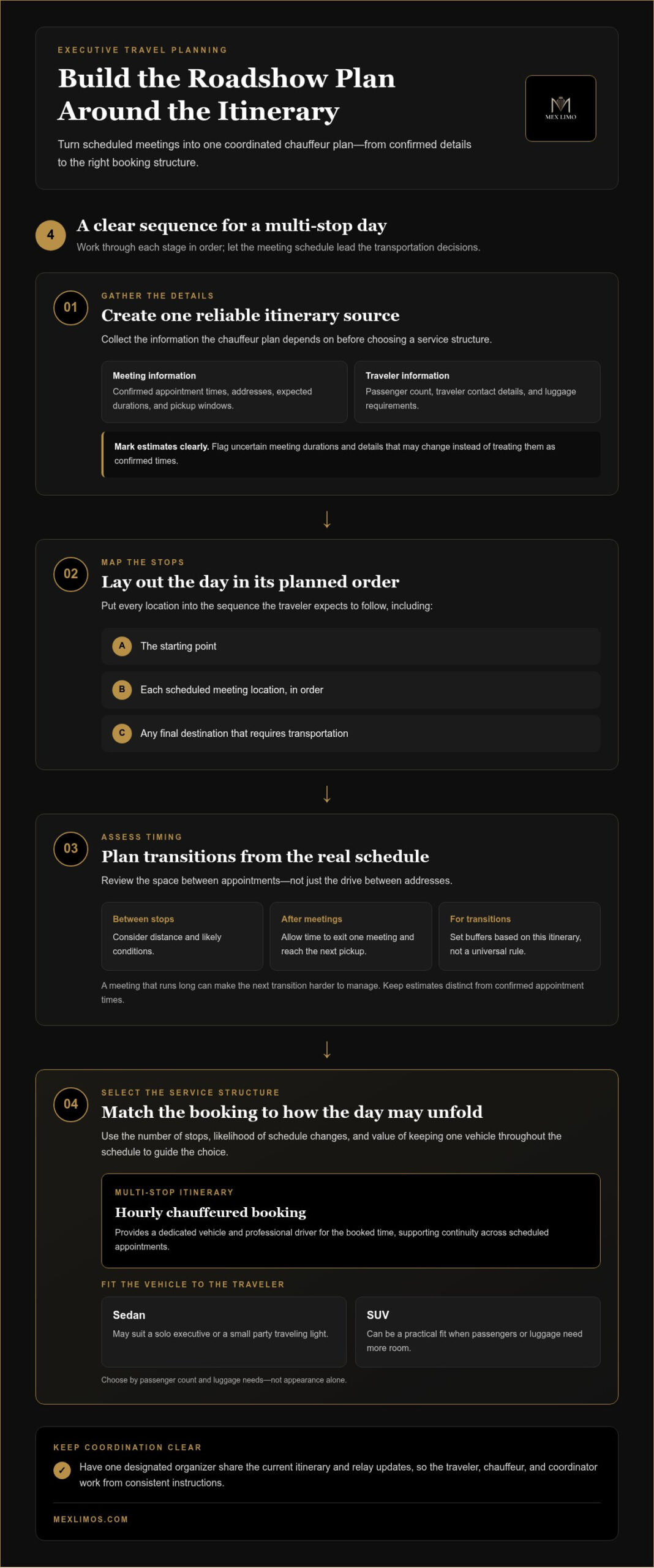
A workable transportation plan begins with the meeting schedule, not the vehicle choice. For roadshow transportation for financial firms, the organizer can turn a sequence of appointments into a clear chauffeur plan by following four steps:
- Collect meeting details. Record confirmed appointment times, addresses, expected duration, pickup windows, passenger count, traveler contact details, and luggage needs.
- Map the stops. Put each location in the planned order, including the starting point and any final destination that requires transportation.
- Assess timing. Consider the distance and likely conditions between stops, along with time to exit one meeting and reach the next pickup. Allow transition buffers based on the actual itinerary instead of applying a universal travel-time rule.
- Select the service structure. Choose an arrangement that reflects the number of stops, likelihood of changes, and value of keeping one vehicle throughout the schedule.
Stop count, schedule flexibility, and vehicle continuity guide the right booking structure. Flag uncertain meeting durations and possible changes during planning, so the transportation plan accounts for them without treating estimates as confirmed appointment times. Have one designated organizer share the current itinerary and relay updates to help prevent conflicting instructions.
Which itinerary details should the organizer prepare?
Bring together confirmed appointment times and addresses, stop sequence, passenger count, traveler contact details, pickup windows, expected meeting durations, and luggage requirements. Mark estimates clearly, especially where a meeting may run longer or timing is still developing. One current itinerary gives everyone a consistent reference and makes it easier for a single coordinator to communicate revisions.
How should the vehicle fit the traveler and the day?
Match the vehicle category to the passengers and what they’re carrying. A sedan may suit a solo executive or a small party traveling light; an SUV can be a practical fit when passengers or luggage need more room. A stretch limousine is not the default for a meeting-led schedule unless that format suits the occasion. Explore chauffeured luxury vehicle options to compare the differences. For a multi-stop day, Mex Limo’s hourly chauffeured bookings provide a dedicated vehicle and driver for the booked time, supporting continuity across scheduled appointments. Learn more about corporate chauffeured travel as you shape the itinerary and booking plan.
Hourly chauffeur or separate rides: compare roadshow booking options
For roadshow transportation for financial firms, the booking structure should reflect how the day is expected to unfold. A run of close-together appointments may call for a different arrangement than two isolated meetings with settled start times. Compare the options by stop count, schedule flexibility, vehicle continuity, and the coordination each requires.
| Booking option | Stop count | Schedule changes | Vehicle continuity | Organizer coordination |
|---|---|---|---|---|
| Hourly booking | Suited to several stops within booked hours | Can accommodate itinerary adjustments within the booked period, subject to booking terms | Same vehicle and driver dedicated for the booked time | One arrangement to coordinate across the scheduled stops |
| Separate point-to-point rides | May suit a small number of isolated transfers | Each ride has its own pickup and timing details | Continuity between rides isn’t built into the structure | More individual ride details to manage |
| Mixed itinerary | Useful when the day combines distinct transfer needs with a multi-stop block | Flexibility depends on how each part is booked | Continuity applies to the portion booked with a dedicated vehicle | Requires clear handoffs between booking segments |
When does hourly chauffeured service suit a roadshow?
Hourly service is a natural fit when several meetings require the same vehicle and chauffeur across a defined stretch of the day. Mex Limo’s hourly chauffeured bookings provide a dedicated vehicle and driver for the booked time, keeping transportation centered on the itinerary rather than a series of separate pickups. Set the planned duration around the full schedule, including expected meeting windows and transitions. Booking requirements and minimum duration depend on the selected vehicle, so match the arrangement to both the itinerary and vehicle category.
Hourly service doesn’t guarantee that delays disappear, and it isn’t automatically the right choice for every schedule. Its value is continuity: the organizer can plan around one booked period and keep the same vehicle for the appointments within it.
When might separate transfers or a mixed plan fit better?
Separate transfers may suit isolated appointments with settled pickup times when the traveler doesn’t need a vehicle dedicated between stops. A mixed itinerary can pair a specific transfer, such as travel to a first appointment, with hourly service for a later block of meetings. This can align the booking structure more closely with how the day is organized.
Before finalizing the plan, compare the schedule against each option and identify who will communicate changes. For more guidance on structuring executive journeys, explore corporate chauffeured travel planning.
How to prepare a financial roadshow itinerary for a smoother travel day
A concise travel brief gives the executive, organizer, and chauffeur one clear reference for the day. For roadshow transportation for financial firms, make each handoff between meetings easy to follow and distinguish confirmed details from possible changes.
What should the roadshow travel brief include?
Prepare a single document or message with the essential details, then share the current version with the people coordinating the trip:
- Meeting sequence: List appointments in order, with confirmed times, addresses, and expected durations. Mark tentative meetings or estimates clearly.
- Pickup instructions: Specify pickup windows and precise pickup points for each leg, including any relevant entrance or meeting point.
- Passenger details: Include the expected passenger count and traveler contact information needed for coordination.
- Practical needs: Note luggage or accessibility considerations when they apply to the travelers.
- Coordinator details: Name the person responsible for itinerary updates and provide their contact information.
Keep confirmed meeting times distinct from provisional appointments, and make final pickup instructions easy to identify. For airport arrival connections, include flight information and the planned onward pickup in the brief. Mex Limo provides real-time flight tracking for airport transfers, which can support coordination around an arriving flight.
Once the checklist is in place, explore corporate chauffeured travel for more guidance on planning executive transportation.
How can organizers handle schedule changes?
Assign one person to communicate updates. If a meeting moves or runs longer than expected, that coordinator can share the revised timing and pickup instructions through the agreed channel, rather than allowing parallel messages to create confusion. Keep the traveler’s and organizer’s contact details accessible with the latest itinerary, so neither has to search through old messages for the current plan.
Build flexibility into the schedule by allowing sensible transition time and identifying tentative appointments. Then communicate changes promptly. A chauffeur can follow updated instructions, but can’t control traffic or determine when a meeting ends. A clear plan helps the team respond without implying that every delay can be avoided.
For a composed handoff from planning to travel, plan your corporate chauffeured journey with the itinerary, passenger details, and update process ready to share.
Book roadshow transportation with Mex Limo for a composed executive journey
A well-organized booking brings the itinerary, service structure, and vehicle choice together. For roadshow transportation for financial firms, decide whether the day calls for dedicated hourly service, individual transfers, or a combination, then match the vehicle to the passengers and their luggage.
Mex Limo Worldwide Chauffeured Service provides corporate chauffeured travel with professional chauffeurs, hourly bookings, and a fleet that includes sedans and SUVs. Hourly bookings provide a dedicated vehicle and driver for the booked time, making them a natural option for a planned series of stops. The company has operated since 2009 and offers 24/7 availability. These details help you plan the service, but they don’t guarantee that traffic or meeting schedules will unfold as planned.
What to include when arranging a chauffeured roadshow
Give the transportation coordinator a clear outline so the booking can be shaped around the actual day. Include:
- Date and stop sequence: List the appointments in order, with addresses and confirmed times where available.
- Approximate timing: Share pickup windows and expected meeting durations, marking tentative details clearly.
- Passenger count and vehicle preference: Note who is traveling and whether a sedan or SUV better suits the group and luggage.
- Booking structure: Indicate whether the itinerary calls for hourly service, separate transfers, or a combination.
These practical details establish a clear plan for the traveler and organizer, while leaving room to communicate changes as the day develops.
Why choose Mex Limo Worldwide Chauffeured Service for corporate travel?
Professional chauffeurs and a dedicated hourly booking bring continuity to a meeting-led schedule, while a suitable sedan or SUV supports a composed, comfortable journey. Choosing the vehicle category based on passenger and luggage needs keeps the arrangement practical as well as polished. Mex Limo Worldwide Chauffeured Service provides corporate chauffeured travel for executive transportation needs.
Share the itinerary and preferred arrangement to begin planning a roadshow journey shaped around the day’s priorities. Arrange your corporate chauffeured journey and request an arrangement tailored to your schedule.
Set Your Roadshow Up for a More Composed Journey
Strong roadshow transportation for financial firms begins with a coordinated itinerary. Match the booking structure to the number of stops and expected schedule changes, choose a vehicle that suits the passengers and luggage, and give the traveler and coordinator one clear plan for pickups and updates.
Mex Limo provides corporate chauffeured travel, hourly bookings, professional chauffeurs, and a fleet that includes sedans and SUVs. When hourly service fits the schedule, a dedicated vehicle and driver are available for the booked time.
Bring your stop sequence, approximate timing, passenger count, and preferred vehicle category together as you plan. Arrange your corporate chauffeured journey with an itinerary-led approach and move forward with a clearer plan for the roadshow.
Frequently Asked Questions
How does roadshow transportation for financial firms work?
The organizer shares the meeting sequence, pickup details, passenger needs, and expected timing so transportation can be arranged around the itinerary. Bookings may use hourly chauffeured service, individual transfers, or a combination. For a multi-stop day, reserving a vehicle and driver for booked time can help coordinate travel between appointments. The plan should reflect the schedule, including tentative meetings and transition windows, rather than rely on a generic route.
Is hourly chauffeur service a good choice for a financial roadshow?
Hourly service can suit a roadshow with several meetings, uncertain appointment lengths, or a need to keep the same vehicle available between stops. It reserves a vehicle and driver for the booked period, supporting continuity across the itinerary. Compare the number of stops and schedule flexibility with separate transfers before deciding. Booking requirements, including any minimum duration, depend on the selected vehicle, so base the planned time on the day’s meeting windows.
What information should I provide when booking roadshow transportation?
Provide the travel date, meeting sequence, pickup locations, approximate appointment times, passenger count, and luggage needs. Include the trip coordinator’s contact details and a reliable way to share updates. If the schedule is still developing, mark confirmed appointments separately from tentative ones. This gives the transportation plan a clear foundation without assuming each meeting will finish exactly on time. Relevant accessibility considerations can also help shape the arrangement.
Which vehicle is best for a financial roadshow?
Choose a vehicle based on passenger count, comfort preferences, and luggage requirements. A sedan may suit an individual executive or a small party traveling light, while an SUV may be a practical fit when the group or luggage needs additional space. Consider the full itinerary and how the vehicle will serve the day, not appearance alone. The best fit is the category that supports a comfortable journey and the travelers’ practical needs.
Can a chauffeur wait between roadshow meetings?
With an hourly chauffeured booking, the vehicle and driver are dedicated for the booked period, which can suit an itinerary with several stops and time between appointments. Share the expected meeting windows and stop sequence so the arrangement reflects the planned day. Don’t assume unlimited waiting time or a particular booking duration; requirements, including minimum duration, depend on the selected vehicle and service. Clear timing details help set a practical plan.
How far in advance should financial firms arrange roadshow transportation?
There’s no single lead time that suits every itinerary. A multi-stop schedule, several passengers, or appointments that are still changing may need more coordination than a straightforward transfer. Start preparing the booking details once meeting dates and locations begin to take shape. Share updates as appointments develop, and distinguish tentative plans from confirmed ones so the transportation arrangement can follow the current itinerary rather than an outdated draft.
Should we book one vehicle for the whole roadshow or separate rides?
Compare the number of stops, certainty of pickup times, and need for vehicle continuity. An hourly booking may simplify coordination when several meetings form one itinerary and the same vehicle is useful throughout the booked period. Separate transfers can suit isolated trips with settled timings, while a mixed plan can combine a specific transfer with dedicated service for a multi-stop block. Choose the arrangement that reflects the actual schedule, not a blanket rule.