
What makes an executive journey feel secure is often not a promise of protection, but a well-coordinated ride with fewer unnecessary details in circulation. Secure ground transportation for executives starts with dependable planning and thoughtful handling of itinerary information, not assumptions that a chauffeur service replaces executive protection.
Executives need privacy, punctuality, and a composed response when flights shift or meetings run long. Professional chauffeured travel can support those priorities through clear coordination, while corporate travel teams decide which passenger and itinerary details are needed for each trip. Mex Limo Worldwide Chauffeured Service provides airport transfers and corporate travel with professional chauffeurs and real-time flight tracking.
This guide covers practical information-handling considerations, explains the difference between chauffeured transportation and protective services, and shows how to match airport transfers or hourly bookings to a single trip or a multi-stop itinerary. You’ll also find ways to reduce friction when plans change, keep the journey organized, and support a discreet travel experience.
Key Takeaways
- Understand what secure ground transportation for executives can support, and where chauffeured transport differs from dedicated protective services.
- Learn how to limit shared itinerary details to what’s needed for the journey while keeping sensitive business information separate.
- Compare airport transfers, hourly service, and protective-detail coordination to find a suitable model for different trip plans.
- Use a practical checklist to organize pickup timing, passenger and luggage needs, mobility requirements, and schedule updates.
- See how professional chauffeurs, real-time flight tracking, and corporate travel service can help bring greater coordination to executive journeys.
What Secure Ground Transportation for Executives Should, and Should Not, Mean
Secure ground transportation for executives is planned, professional travel that prioritizes dependable coordination and appropriate discretion. It is not, by itself, a protective detail or a guarantee against threats. This distinction helps corporate travel teams choose a service suited to the journey without confusing comfortable, reliable logistics with specialized security.
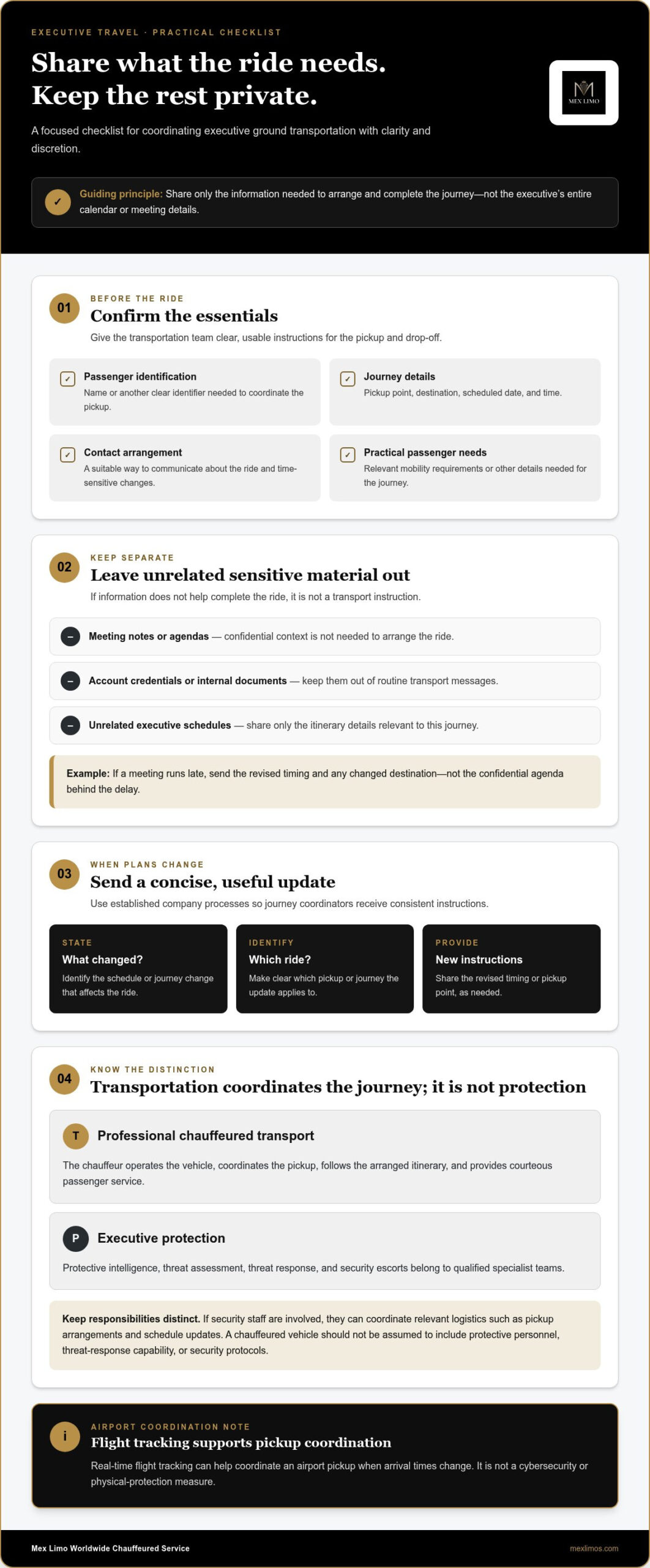
A well-organized trip starts with clear practical details: the pickup point, a usable contact method, an accurate schedule, and a process for communicating changes. Privacy matters too. Share the information needed to arrange and complete the ride, rather than circulating meeting agendas or other sensitive material that has no bearing on the transportation.
Professional chauffeured transport versus executive protection
A chauffeur’s role is transportation: operating the vehicle, coordinating the pickup, following the arranged itinerary, and providing courteous passenger service. Executive protection serves a different purpose. Protective intelligence, threat assessment, threat response, and security escorts belong to qualified specialist teams. The distinction is reflected in the broader field of Dignitary Protection, which concerns safeguarding individuals rather than simply conveying them from one destination to another.
A chauffeured vehicle should not be assumed to include protective personnel, threat-response capability, or security protocols. If an organization has security staff, those specialists can coordinate relevant logistics with the transportation team, such as pickup arrangements and schedule updates. Each team retains its distinct responsibilities, and sensitive operational information can be limited to people who need it.
Why executive journeys need more than a ride
A missed connection or unclear pickup can disrupt more than a transfer. An executive arriving late may lose preparation time, delay a meeting, or require colleagues to revise a carefully planned schedule. Clear arrangements help prevent avoidable confusion: specify the pickup point, identify the passenger or party, and establish how everyone will communicate if a flight or meeting time changes.
Consider an itinerary with an airport arrival followed by a client meeting. If pickup instructions are vague, the passenger may have to search for the vehicle or make repeated calls. A professional chauffeured service brings structure to the journey through pickup coordination and attentive passenger service. Mex Limo’s real-time flight tracking can also support airport pickup coordination when arrival times change, but it is not a cybersecurity or physical-protection measure.
Discretion is equally practical. Consistent, composed service can help an executive move between appointments without drawing unnecessary attention, while careful information sharing reduces exposure of irrelevant itinerary details. Neither a polished vehicle nor luxury amenities alone make a journey secure. Thoughtful planning, accurate communication, and a clear understanding of what transportation does and does not provide are more useful foundations.
How Transport Planning and Data Minimization Support Executive Travel
Well-planned transportation depends on accurate instructions, but a booking doesn’t require an executive’s entire calendar or the substance of their meetings. Transport coordination should use only information relevant to completing the trip. This principle, known as data minimization, helps travel teams provide the details needed for a smooth pickup while keeping unrelated business and personal information out of routine transport messages.
It also makes coordination clearer. A chauffeur needs practical journey instructions, not confidential context that has no bearing on the ride. Security Magazine’s overview of Executive Travel Security: How to Protect Executives During Travel places transportation within a broader travel-security plan, highlighting why organizations should keep logistics and security processes purposeful and distinct.
Which itinerary details are relevant to a ride?
For an airport transfer or business journey, travel coordinators can focus on the details needed to complete the pickup and drop-off as planned:
- Passenger identification: The passenger’s name, or another clear identifier needed to coordinate the pickup.
- Journey details: Pickup and destination information, along with the scheduled date and time.
- Contact arrangements: A suitable method for communicating about the ride, including a channel for time-sensitive changes.
- Practical passenger needs: Relevant mobility requirements or other details needed to support the journey.
Meeting notes, account credentials, internal documents, and unrelated executive schedules are not transport instructions. If a meeting runs late and affects a pickup, communicate the revised timing and any changed destination, not the confidential agenda behind the delay. This keeps the update focused and useful.
Send necessary changes through established company processes so the people coordinating the journey receive consistent instructions. A concise update can state what changed, which ride it affects, and the new timing or pickup point. That is more useful than forwarding a full calendar or a long message thread containing unrelated details.
How to keep transport coordination proportionate
Limit itinerary distribution to colleagues who need it to arrange, oversee, or update the journey. A travel coordinator may need the full transport schedule, while a colleague supporting one pickup may need only that leg’s time and location. Use organization-approved communication channels and records practices for sensitive details, and follow company guidance on who can make or authorize changes.
Keep access decisions separate from transport instructions. If an executive’s destination involves a controlled facility or a sensitive meeting, follow the organization’s established procedures for access and security rather than placing credentials or confidential documents in routine ride communications. Transportation coordination can communicate the destination without carrying materials used to enter or conduct business there.
These practices support secure ground transportation for executives by making the journey easier to coordinate without implying that a transport provider has specific data-security controls. For corporate itineraries requiring coordinated chauffeured travel, corporate chauffeured service can be part of a thoughtfully planned transport arrangement.
Comparing Executive Ground Transportation Models for Different Trips
The right format depends on the itinerary. A single airport journey has different coordination needs from a day of appointments, while travel involving a protective detail requires security planning beyond the transportation booking. Use this comparison to match the arrangement to the journey without treating a vehicle type or booking format as a security measure.
| Model | Itinerary shape | Schedule flexibility | Passenger needs | Security support |
|---|---|---|---|---|
| Individual airport transfer | One defined pickup and destination, such as an airport arrival followed by a hotel or office transfer. | Organized around a specific journey; flight updates can inform pickup coordination. | Useful for an individual or a group with a known passenger count, luggage, and destination. | Transportation coordination only. It does not itself provide a protective detail. |
| Hourly chauffeured service | A sequence of appointments, such as a corporate roadshow or several meetings in one business day. | Supports a planned itinerary with the vehicle and chauffeur retained across scheduled stops. | Suited to executives or teams moving between multiple destinations. | Transportation coordination only. Any protective support remains a separate specialist function. |
| Protective-detail coordination | Movement planned alongside an organization’s security requirements and specialist personnel. | Set by the security plan and the journey’s operational needs. | For travelers whose organization has determined that dedicated protective support is appropriate. | Provided by the qualified security team, not created by choosing a transfer or hourly booking. |
When a direct airport transfer fits the itinerary
A point-to-point airport transfer suits a journey with a defined arrival or departure, pickup location, and destination. It keeps the booking focused on one movement rather than holding a vehicle across a full business day. Mex Limo’s real-time flight tracking supports pickup coordination when arrival times shift, helping the transport plan respond to updated flight information. If a meet-and-greet arrangement is part of the travel plan, include clear meeting instructions without assuming a particular terminal procedure.
For example, an executive arriving for a single meeting may need a transfer from the airport to the meeting location, followed by a separate ride later. Clear pickup instructions and current arrival details make the arrangement easier to coordinate.
When hourly chauffeured service supports a business day
Hourly service can suit a corporate roadshow, a sequence of client meetings, or a day when an executive needs transportation between several scheduled stops. Keeping a vehicle and chauffeur with the itinerary reduces the need to coordinate a separate booking for each leg, while allowing the travel team to plan the day as one connected movement. It supports coordination, not protective coverage.
For guidance on organizing this kind of itinerary, explore corporate chauffeured travel guidance. Choosing secure ground transportation for executives means matching the transportation format to the trip and arranging any distinct protective support through the organization’s security team.
A Practical Planning Checklist for Secure Executive Ground Transportation
A considered transport plan gives the executive, travel coordinator, and chauffeur a shared understanding of the journey without circulating unnecessary information. Use this sequence to organize the booking, confirm practical needs, and keep transportation logistics distinct from protective arrangements.
Prepare a clear, proportionate trip brief
Before booking, gather the details needed to arrange the ride. A concise brief helps prevent avoidable confusion while keeping sensitive business information out of routine transport instructions.
- 1. Define the trip. Note whether it’s an airport transfer, a single point-to-point journey, or a day with multiple stops. Record the pickup and destination, date, requested pickup time, and relevant schedule.
- 2. Select the service format. Match the booking to the itinerary: a direct transfer for a defined journey or hourly chauffeured service for a planned sequence of appointments. Consider whether a sedan, SUV, or passenger van best suits the passenger group and luggage. The chauffeured luxury vehicle guide can help travel planners compare vehicle categories.
- 3. Coordinate essential details. Provide the passenger name or clear identifier, passenger count, pickup location, destination, and a contact method for trip updates. Include luggage needs and relevant mobility or accessibility requirements so the arrangement reflects the passenger’s practical needs.
- 4. Review the plan. Check that pickup timing aligns with the itinerary, locations are clear, and the passenger and coordinator know how to communicate. For airport journeys, include flight details needed for pickup coordination.
Keep the brief focused. Meeting agendas, account credentials, internal documents, and unrelated calendar entries don’t belong in transportation instructions. If a schedule or pickup changes, share the update through the company’s established travel communication process, with only the information needed to act on it.
Coordinate transport with corporate travel and security teams
Assign one travel coordinator or executive assistant to own the booking details and relay approved updates. A clear point of coordination can reduce conflicting instructions, especially when an itinerary includes several stops or changes during the day. The coordinator can also ensure the passenger has the correct pickup information and a suitable contact method.
For a security-sensitive journey, corporate security personnel should define separate protective requirements, access decisions, and escalation procedures. The transportation plan can support the agreed logistics, but a chauffeur booking does not establish who may access a facility or how a security incident should be handled. Keep those decisions within the company’s existing procedures for sensitive itineraries and passenger information.
With responsibilities clear and trip details carefully scoped, plan corporate chauffeured transportation around the journey’s practical needs.
How Mex Limo Supports Executive Ground Transportation
Mex Limo Worldwide Chauffeured Service provides professional transportation for corporate journeys, with service options that support trip coordination and help travel planners choose an arrangement suited to the day’s itinerary. The distinction remains important: Mex Limo is a chauffeured transportation provider, not an executive-protection or cybersecurity firm. Chauffeured service organizes the ride; any protective detail or security procedures remain the responsibility of the organization’s qualified security personnel.
For travel coordinators, the practical value lies in matching a clear transportation plan to the executive’s schedule. Airport transfers address defined trips to or from an airport, while hourly service can support business days with several scheduled stops. Professional chauffeurs and real-time flight tracking support transportation coordination, and 24/7 availability serves a range of travel schedules. Flight tracking helps coordinate airport pickups as arrival information changes; it is not a physical-security or data-security measure.
Transport options for airport trips and multi-stop days
A direct airport transfer suits a specific pickup and destination, such as an arrival followed by a ride to a meeting or hotel. For a roadshow or a day of back-to-back appointments, hourly chauffeured service can keep transportation organized around the planned sequence, rather than requiring a separate arrangement for each leg. Choose the service format based on the itinerary, passenger needs, and schedule.
Vehicle categories include sedans, SUVs, and passenger vans, giving planners options for different passenger groups and travel requirements. Choosing among them is a practical transportation decision, not a security designation. The vehicle category alone does not establish protective coverage, specialized equipment, or threat-response capability.
As part of a broader approach to secure ground transportation for executives, travel teams can coordinate the ride with their own privacy and security processes. Share journey details needed to arrange transportation, and keep protective requirements and sensitive access decisions with the appropriate corporate team. This separation allows each part of the travel plan to serve its intended purpose.
A composed next step for travel planners
Before arranging a journey, consider its shape: a single airport trip, a multi-stop business itinerary, or a combination of both. Then account for passenger count, luggage, mobility requirements, pickup timing, and the preferred service format. These details help frame a clear transportation request without treating chauffeured service as a substitute for dedicated protection.
Mex Limo has operated since 2009, providing chauffeured transportation for corporate travel and airport journeys. Explore corporate chauffeured travel and plan a trip around the schedule and passenger needs.
Make the Next Executive Journey Easier to Coordinate
Use the next trip to make your company’s travel process more intentional. Decide who owns the booking, which itinerary details are necessary for transportation, and how schedule changes should reach the right people. When those responsibilities are clear before departure day, executives and coordinators can focus on the purpose of the journey instead of sorting out avoidable logistics.
Secure ground transportation for executives works best as one considered part of a broader corporate travel plan. Match the transport arrangement to the itinerary, keep information sharing proportionate, and involve your organization’s security personnel when separate protective planning is needed. These steps bring clarity without asking a chauffeured ride to serve a purpose beyond transportation.
For your next airport transfer or business itinerary, book executive transportation with Mex Limo and choose the service format that fits the journey.
Frequently Asked Questions
What does secure ground transportation for executives mean?
Secure ground transportation for executives generally means a planned, professional journey that gives suitable attention to reliability, discretion, and coordination. The phrase can also describe transportation accompanied by specialist protective services, which is a different scope. For example, a company arranging an ordinary airport transfer should describe it as chauffeured transportation in its travel plan, rather than implying that the ride includes threat assessment or protective response.
Does a chauffeur service provide executive protection?
No. A chauffeur service focuses on operating the vehicle, coordinating the ride, and providing passenger service. Executive protection involves separate expertise and security procedures. If a company has a protective team, that team can determine security requirements and share relevant transport logistics, such as an approved pickup adjustment. Keeping these responsibilities distinct helps executives understand whom to contact about routine travel changes and whom to contact about security concerns.
What information should a company share when booking executive transportation?
Share the passenger identifier, pickup and destination, schedule, useful contact arrangements, and relevant luggage or mobility needs. For instance, a coordinator can provide a revised pickup time if a meeting moves, without forwarding meeting notes or an entire calendar. A short, trip-specific brief gives transportation personnel practical instructions while helping the company avoid including confidential business context that has no bearing on completing the journey.
How can a company reduce itinerary privacy risks during ground transportation?
Keep a transport brief separate from any confidential master itinerary, and give each colleague only the journey details needed for their role. Use company-approved channels and information-handling procedures, particularly if a trip involves sensitive appointments. Avoid placing meeting content, credentials, or unrelated schedule entries in booking messages. These steps reduce unnecessary circulation of information, but they don’t establish or verify a provider’s data storage, encryption, or access practices.
Can real-time flight tracking help with an executive airport pickup?
Yes. Flight tracking gives a transportation provider updated flight progress to support pickup coordination when an arrival time changes. Include the correct flight information in the booking and keep a clear passenger contact arrangement for changes that flight status alone won’t explain, such as a revised destination. Mex Limo provides real-time flight tracking as part of its service. It supports coordination, but doesn’t guarantee a particular response to every disruption.
When is hourly chauffeured service useful for corporate travel?
Hourly chauffeured service can work well when the itinerary includes several planned stops, such as a roadshow with meetings at different offices during one business day. It keeps transportation arranged across the scheduled block instead of treating every leg as a separate trip. For a single airport-to-destination journey, a direct transfer may be a simpler fit. The choice depends on the day’s sequence, passenger needs, and expected schedule flexibility.