
The most polished ride isn’t automatically the lower-impact choice. Eco-friendly luxury transportation options are best judged by the journey they serve, not by a vehicle’s prestige or a green label. A short transfer with several passengers raises different questions from a solo trip, and occupancy, distance, energy source, and vehicle size all affect how to assess a journey’s environmental impact.
You can look for lower-impact travel without giving up privacy, comfort, or dependable timing. But labels such as “sustainable” can hide important differences, and a mode that suits one itinerary may be impractical for another. Start with details you can compare, rather than a claim that simply sounds reassuring.
This 2026 guide compares premium ground transportation, rail, commercial and private aviation, and water travel by likely impact, comfort, and suitability. You’ll learn why passenger occupancy and trip purpose matter, what environmental information can establish, and how chauffeured sedans, SUVs, and passenger vans may suit journeys where coordinated, direct service is a priority. Comfort and service alone are not evidence of emissions savings.
Key Takeaways
- Compare eco-friendly luxury transportation options by the whole journey, including energy source, route, and passenger count, rather than relying on premium or green labels.
- Assess occupancy carefully: a vehicle’s impact per passenger can look different when it carries one person versus a group.
- Match the travel mode to your itinerary by weighing privacy, flexibility, passenger needs, and the evidence behind environmental claims.
- Before choosing, consider practical details such as schedule, luggage, accessibility, privacy, and planned stops.
- Chauffeured sedans, SUVs, stretch limousines, and passenger vans offer distinct ways to plan a comfortable, coordinated trip, but comfort does not measure environmental impact.
What Makes Luxury Transportation Eco-Friendly, and What Does Not?
A polished cabin, attentive service, and premium badge describe the passenger experience, not a journey’s environmental performance. To compare eco-friendly luxury transportation options fairly, look at the specific vehicle, its energy source, the route, and how many passengers share the trip. No single label tells the whole story.
A useful definition: “Eco-friendly transportation is a relative judgment supported by evidence about a specific trip’s emissions and broader environmental impacts, not a quality conferred by luxury branding alone.” This separates broad claims from measurable evidence. A vehicle may have features associated with lower impacts, but those features alone do not establish the impact of a particular journey.
- Vehicle: Size, design, and powertrain influence energy use.
- Energy source: Tailpipe emissions and the impacts of producing electricity or fuel are different parts of the picture.
- Occupancy: The number of passengers affects how a trip’s impact is considered per traveler.
- Route: Distance, traffic, detours, and extra stops affect the journey being assessed.
What does eco-friendly mean for a single journey?
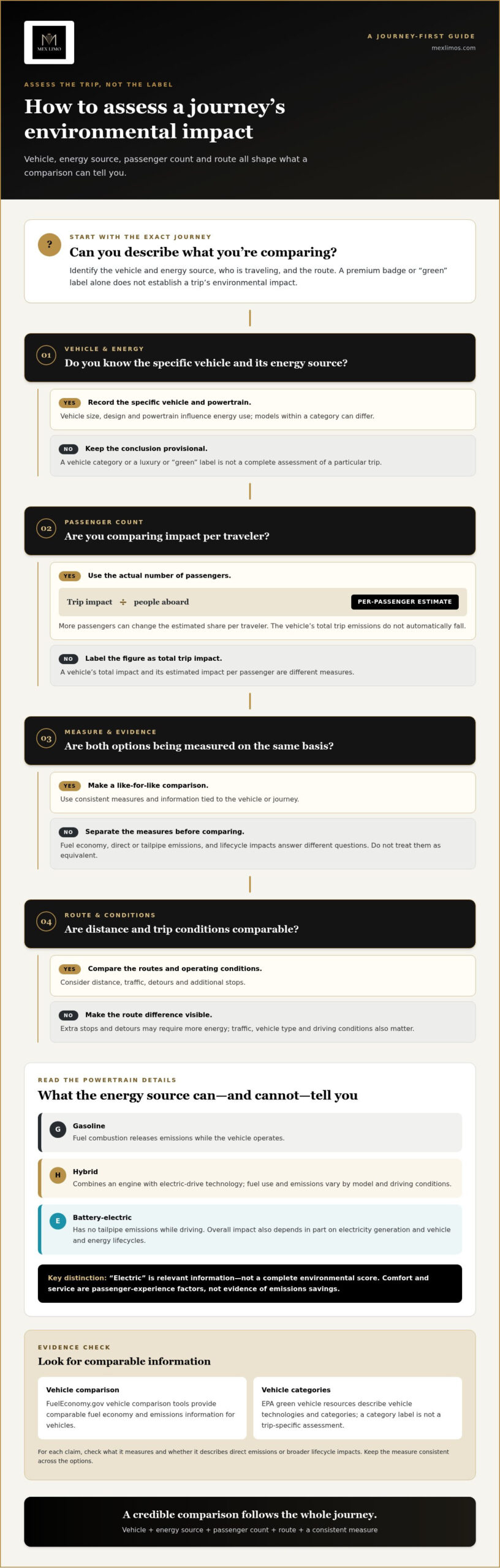
Start with the exact vehicle and energy it uses, then consider the trip conditions. Direct vehicle emissions occur during operation. Lifecycle considerations also include producing the vehicle and supplying its electricity or fuel. These are distinct measures, so a comparison based only on tailpipe emissions may not represent the full picture. The U.S. Department of Energy and EPA’s FuelEconomy.gov vehicle comparison tools provide comparable fuel economy and emissions information for vehicles. The broader Green Vehicle Definition and Types overview describes vehicle categories, but a category label is not a trip-specific assessment.
Can luxury and lower-impact travel coexist?
Yes, but assess comfort and environmental performance separately. A private chauffeured ride can provide privacy, direct service, and coordinated timing. Those advantages don’t prove it produces fewer emissions. Likewise, an electric vehicle’s lack of tailpipe emissions doesn’t mean its entire lifecycle has no environmental impact. Look at what a claim measures, and don’t treat a premium experience as evidence of sustainability.
Trip planning can make the comparison more useful. If several people are traveling to the same destination, assess one appropriately occupied vehicle per passenger rather than comparing only vehicle totals. Consolidating stops may also avoid additional journeys, provided it doesn’t create a longer or less efficient route. The result depends on the vehicles, actual occupancy, distance, and energy sources involved, so these choices shouldn’t be presented as guaranteed emissions reductions.
For a credible comparison, look for evidence tied to the journey or vehicle. Note whether figures describe direct or lifecycle impacts, and use consistent measures across the options. “Premium,” “green,” and “clean” are positioning terms unless supported by specific, comparable information.
How Vehicle Type, Occupancy, and Routing Shape Travel Impact
Start with the journey, not a blanket ranking of vehicle categories. Trip impact depends on the vehicle, its energy source, passenger occupancy, and route. Each factor changes what a comparison can tell you, and a result for one itinerary may not apply to another.
Why vehicle and energy source matter
Gasoline vehicles release emissions from fuel combustion as they operate. Hybrids combine an engine with electric-drive technology, but their fuel use and emissions vary by model and driving conditions. Battery-electric vehicles have no tailpipe emissions while driving, yet their overall impact also depends in part on how electricity is generated and on effects across the vehicle and energy lifecycles. “Electric” is relevant information, not a complete environmental score.
For a like-for-like comparison, use data for the specific vehicle rather than assuming every model in a category performs identically. The EPA’s green vehicle resources help consumers understand vehicle technologies and related programs. Its EPA Initiatives for Green Vehicle Promotion page provides context on education and support for greener vehicle choices. Keep the measure consistent: fuel economy, tailpipe emissions, and lifecycle impact each answer a different question. Don’t combine figures with different boundaries as if they were directly equivalent.
How passenger count and route change the comparison
A vehicle’s total trip impact and its estimated impact per passenger are different measures. For a simple per-passenger estimate, divide the trip’s total impact by the number of people aboard. If the same vehicle makes the same trip with more passengers, its total emissions don’t automatically fall, but the estimated share per traveler may be lower. This allocation helps compare passenger travel; it doesn’t prove that a larger vehicle or private ride is inherently more efficient.
Consider two itineraries covering the same distance. One is direct, while the other adds stops and detours. The second may require more energy, though traffic, vehicle type, and driving conditions also matter. Fewer separate journeys or consolidated stops can be relevant if they genuinely replace additional travel. Don’t assume a chauffeured trip replaces several individual vehicles; compare the actual plans.
- Identify the vehicle and energy source rather than relying on labels such as “green” or “premium.”
- Compare total-trip and per-passenger impacts separately, using the actual passenger count.
- Review the route and planned stops so the comparison reflects the journey you intend to take.
These distinctions help you weigh comfort and environmental evidence on their own terms. If privacy and coordinated direct service are priorities, explore chauffeured sedan and SUV travel as a journey-planning option, then assess its environmental impact separately from its service benefits.
Eco-Friendly Luxury Transportation Options Compared by Journey
No mode suits every itinerary. Balance environmental evidence with practical needs: where you’re going, how many people are traveling, how much flexibility you need, and whether privacy matters. The options below serve different journeys, so treat them as choices to assess rather than a universal ranking.
| Option | May suit | Privacy, passengers, and flexibility | Evidence to compare |
|---|---|---|---|
| Public transit | A city-to-city or airport journey where routes and timetables align. | Usually less private; works best when travelers can use the same service and manage transfers and luggage. | Route, service schedule, energy source, and a consistent per-passenger comparison. |
| Shared travel | Passengers traveling along similar routes or a group making the same trip. | Less control over stops and timing than a private ride; suitability depends on whether the group can travel together. | Actual occupancy, route, detours, and whether the shared trip replaces separate journeys. |
| Electric vehicle | A trip where a suitable EV and workable charging plan fit the itinerary. | Can offer private travel; flexibility depends on vehicle access, charging availability, and route length. | Vehicle-specific energy use, electricity context, and whether the figure covers tailpipe or lifecycle impacts. |
| Chauffeured service | Airport transfers, events, business travel, or itineraries where direct service and coordination matter. | Private and flexible for the booked journey; vehicle categories accommodate different passenger and luggage needs. | Specific vehicle, energy source, occupancy, distance, and route. Premium service alone doesn’t establish lower impact. |
When transit, shared travel, or an electric vehicle may fit
Consider public transit when service times, transfers, and luggage requirements work with your schedule. Shared travel can suit companions headed to the same destination, while an EV may fit a private journey if charging aligns with the route. Each option still needs trip-specific assessment: availability, actual occupancy, and energy source can change the comparison.
Where chauffeured transportation fits the decision
When an itinerary calls for privacy, professional driving, and coordinated stops, chauffeured service offers a distinct kind of convenience. A sedan may suit a smaller party; an SUV, stretch limousine, or passenger van can meet different passenger and luggage needs. Choose a category based on the occasion and occupancy, not an assumed environmental advantage. For more on vehicle categories and uses, see this chauffeured luxury vehicles guide.
For example, a traveler with a flexible schedule and a convenient transit connection may favor public transport. Colleagues traveling together with luggage may value direct, coordinated service. Neither scenario proves a lower trip impact by itself. Compare the actual passenger count and itinerary, then weigh environmental evidence separately from comfort, privacy, and convenience.
A Practical Checklist for Choosing a More Considered Premium Journey
Start with the itinerary, not a vehicle label. Clarify what the journey needs to accomplish, then compare realistic travel modes against practical requirements and credible environmental evidence. An airport transfer, a solo business trip, and a multi-stop group outing can call for different arrangements.
Use this sequence:
- Define the journey. Note the start and end points, timing, purpose, and planned stops.
- Count passengers. Include everyone traveling, then consider luggage and accessibility needs alongside passenger capacity.
- Compare suitable modes. Assess public transit, shared travel, an electric vehicle, or chauffeured service only where each realistically fits the itinerary.
- Review the evidence. Identify the vehicle, energy source, measurement basis, reporting period, and assumptions behind any environmental estimate.
- Select the service. Balance the evidence with schedule, privacy, comfort, and the coordination the journey requires.
Match the transport option to the trip
For solo travel, a convenient transit schedule may be practical if connections and luggage are manageable. Groups traveling together can compare shared schedules with a direct ride, while an airport transfer may require dependable timing and room for bags. Multi-stop itineraries need flexibility; direct service can suit several appointments or event logistics. For executive itineraries, corporate chauffeured travel guidance offers useful business-mobility context.
Check the details that affect convenience: departure windows, walking or transfer time, luggage volume, accessibility requirements, privacy, and planned stops. A mode that suits a traveler with a flexible schedule may not fit a tight connection or a group coordinating several arrivals. Choose a service for the actual party and itinerary, not a general preference for one category.
Assess environmental claims without guesswork
Look for a clearly identified vehicle type and energy source, plus the basis of the estimate: total trip or per passenger, tailpipe emissions or broader lifecycle impacts, and the period the data covers. Compare like with like, including similar routes, occupancy assumptions, and measurement boundaries. If a claim omits key assumptions or compares unlike journeys, treat it as inconclusive rather than proof of a better option.
“Define the trip, count the travelers, compare realistic modes, review the evidence, then choose the service that fits.” This checklist makes eco-friendly luxury transportation options a practical decision while keeping environmental claims distinct from comfort and hospitality.
For a coordinated chauffeured itinerary, plan your chauffeured journey around the passengers, schedule, and stops that matter.
How Mex Limo Supports a Refined, Well-Planned Journey
A well-planned ride can bring comfort, privacy, and coordination to an important itinerary. Mex Limo Worldwide Chauffeured Service provides airport transfers, corporate travel, wedding limousine service, and transportation for events. These are premium service benefits, not an environmental certification: a luxury experience by itself doesn’t establish a journey’s emissions or overall impact. Keep those questions separate when comparing options.
A chauffeured option for business, airport, and event travel
Professional chauffeurs support a composed experience, while real-time flight tracking helps coordinate airport pickups around flight information. Mex Limo also provides corporate travel, wedding journeys, and special-event transportation, where timing, privacy, and a polished arrival may be priorities. For celebrations that call for a formal entrance and coordinated transportation, the wedding limousine services guide offers context for planning event travel.
Vehicle categories offer different ways to match the ride to the occasion and passenger needs. Mex Limo provides luxury sedans, luxury SUVs, stretch limousines, and passenger vans. Instead of choosing by appearance alone, consider how many people are traveling, their luggage, the itinerary, and whether the occasion calls for a formal style. The aim is to select a vehicle category that suits the journey, not to make an unsupported environmental claim.
- Airport journeys: Flight tracking and professional pickup coordination help organize airport transfers.
- Business travel: Chauffeured service can support privacy and a composed schedule between appointments.
- Weddings and events: Limousines, sedans, SUVs, and vans offer different service styles for occasion travel.
- Group itineraries: Passenger vans can suit several travelers making the same journey.
Plan your next journey with confidence
Bring the practical details together before selecting a service: passenger count, luggage, timing, itinerary, occasion, and number of stops. A sedan may suit a different plan than a van or stretch limousine. Direct chauffeured transportation can be a considered choice when coordination and privacy matter. Mex Limo’s 24/7 availability supports varied schedules, while environmental comparisons should still rely on evidence about the specific vehicle, energy source, occupancy, and route.
For travelers weighing eco-friendly luxury transportation options, distinguish a refined experience from a substantiated impact claim. Choose a service around what the journey requires, then evaluate environmental information using comparable, trip-relevant evidence. This keeps comfort, convenience, and environmental performance in view without overstating what any one option can deliver.
Explore Mex Limo’s chauffeured transportation services to plan an airport transfer, business itinerary, wedding ride, or event journey around your passengers and schedule.
Make Your Next Journey a More Informed Choice
Let your next booking reflect what matters most that day. A tight connection, a formal occasion, and a flexible personal trip call for different priorities, so decide which needs are essential before choosing a mode. If environmental performance matters, keep the evidence separate from the service experience: compare information about a similar journey, and don’t let a polished label make the decision for you.
Noting what worked can make future planning easier. Keep a simple record of the details that shaped your choice, such as passenger needs, timing, route, and the environmental information available. This gives you a more useful basis for future decisions about eco-friendly luxury transportation options, without assuming one mode is right for every trip.
For your next itinerary, choose the comfort and coordination that suit the occasion, then assess environmental claims on their own evidence. Explore Mex Limo’s chauffeured transportation services and plan a journey around your needs.
Frequently Asked Questions
Are luxury transportation options eco-friendly?
Not automatically. Luxury describes comfort or service, while environmental performance depends on the vehicle and the particular journey. A premium sedan and a premium SUV, for example, may differ in energy use, and occupancy changes how a per-passenger comparison looks. Treat terms such as “green” as claims to evaluate, not proof. Look for information identifying the vehicle, energy source, and measurement behind the claim.
Can a chauffeured car be a more sustainable choice for a group?
It can be a reasonable option if the group would otherwise make several separate trips, but the outcome depends on the vehicles and routes being compared. A single car carrying colleagues to the same venue may divide its journey impact among more passengers. If the group requires a larger vehicle or makes extra stops, the comparison may change. Assess actual occupancy and the realistic alternative rather than assuming group travel always has a lower impact.
Is an electric luxury vehicle always better for the environment?
No vehicle type is automatically better across every environmental measure. An electric vehicle has no tailpipe emissions while driving, but electricity generation affects its operating footprint, and manufacturing and energy supply matter in a broader lifecycle assessment. Compare the specific vehicle, its energy use, and the electricity context, then check whether the figures cover driving emissions alone or a wider lifecycle. “Electric” is a useful detail, not a complete verdict.
How can I compare the environmental impact of different transportation options?
Compare options for the same journey using the same kind of measure. Set a shared route and passenger count, for example, then distinguish total trip emissions from an estimate per traveler. Check whether figures cover tailpipe emissions or lifecycle impacts, and note the source and assumptions. Transit data may use a different basis from vehicle data, so don’t treat them as directly comparable unless their boundaries match. If key details are missing, regard the result as uncertain.
What is the most eco-friendly way to travel for a special event?
There isn’t one best option for every event. A venue near a useful transit connection may make public transport practical, especially for guests traveling light and able to follow set schedules. Guests arriving together from the same place may be able to share a ride; those with mobility needs, formal attire, or several stops may need more direct arrangements. Consider the guests’ complete journeys, not only the vehicle used for the final leg.
Does combining stops make a chauffeured journey more eco-friendly?
Not necessarily. Combining stops may avoid separate journeys if it genuinely replaces trips people would otherwise make. But detours, waiting, or extra distance can increase vehicle use, and the effect depends on route and occupancy. One planned pickup on the way to an event, for instance, is different from driving across town for several unrelated errands. Judge the complete itinerary against the trips it replaces rather than counting stops alone.