
A cruise ship will never hold its gangway for a delayed rideshare, unexpected highway congestion, or a luggage mishap. While embarkation morning should mark the celebratory beginning of an indulgent voyage, strict maritime deadlines frequently turn that final leg of travel into an ordeal of frantic clock-watching and terminal confusion. Meticulous pre-cruise transportation planning transforms this high-stakes departure into an effortless, graceful experience where punctuality meets complete peace of mind.
You shouldn’t have to spend the start of your holiday worrying about whether multiple oversized suitcases will fit into a compact trunk or if a late driver will jeopardize your boarding window. With the proper logistical strategy, you can command your embarkation day with absolute confidence and zero friction. Ahead, you’ll find a structured timeline checklist covering every critical milestone from weeks out down to departure morning, alongside clear criteria for selecting spacious private transport and mastering pier-side luggage logistics.
Key Takeaways
- Understand strict maritime manifest submission deadlines and why structured arrival timing protects you from a closed gangway.
- Implement an actionable pre-cruise transportation planning checklist that aligns your flights, hotel stays, and pier check-in appointments.
- Discover why dedicated chauffeured transport eliminates the surge pricing, cancellation risks, and vehicle trunk limitations common to standard rideshares.
- Identify the ideal fleet configuration, from executive sedans to spacious passenger vans, to comfortably accommodate your travel group and multi-week luggage.
- Navigate busy cruise terminal gates effortlessly by utilizing professional commercial lane privileges and coordinated pier-side luggage handling.
Understanding Pre-Cruise Transportation Planning and Embarkation Deadlines
True pre-cruise transportation planning is far more than booking an airport ride; it is the comprehensive, end-to-end management of your entire journey across air corridors, arterial highways, and port entry checkpoints. Unlike standard leisure travel where a 30-minute delay simply pushes back dinner, embarking on modern cruise ships requires absolute precision. Maritime vessels operate under unyielding federal safety regulations that govern harbor departures, pilot navigation schedules, and passenger manifest clearances. When any single link in your transit chain fractures, the entire departure window can collapse before you ever reach the water.
The Anatomy of Maritime All-Aboard Cutoffs
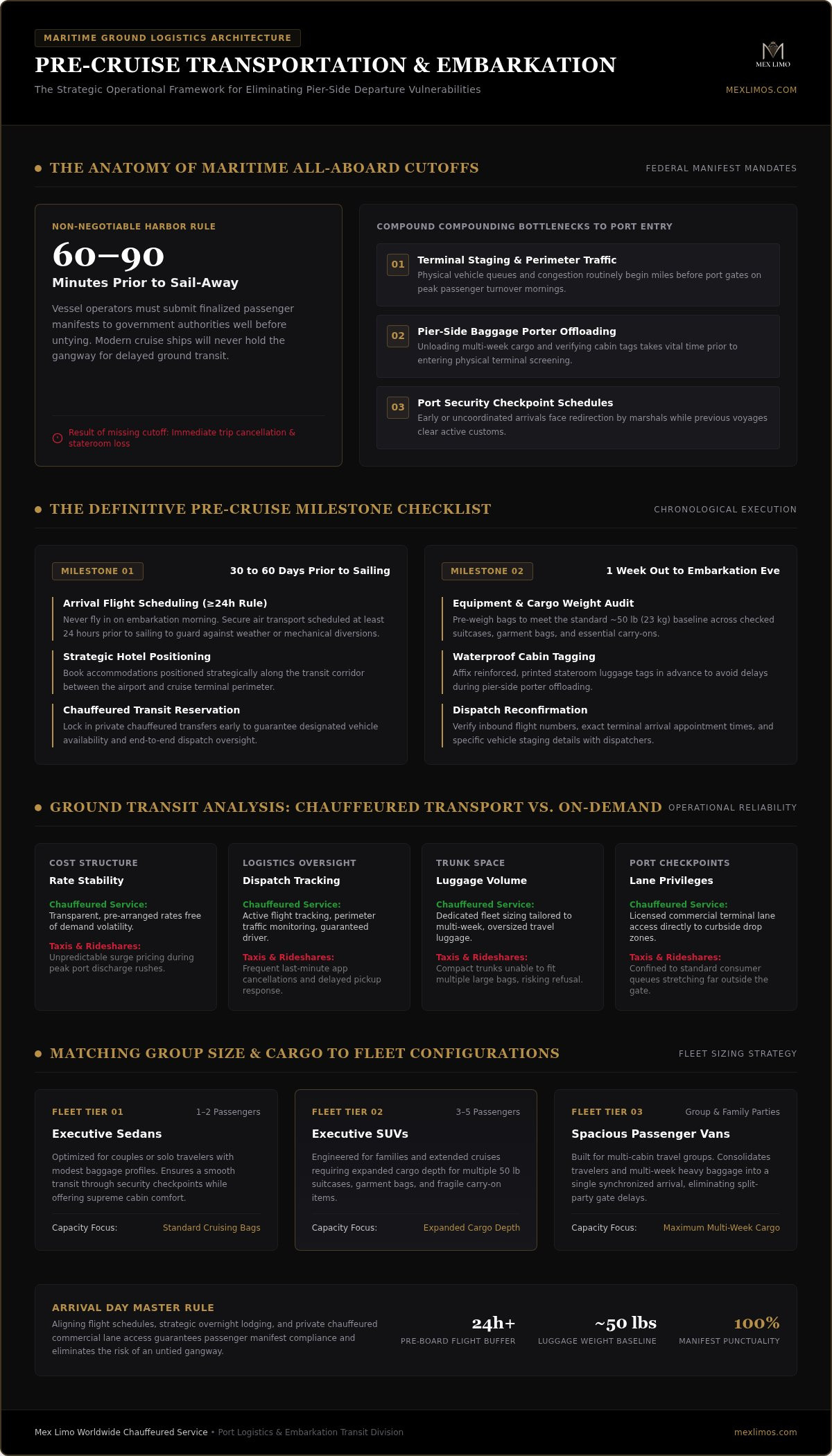
Many travelers mistake their designated terminal arrival appointment for the ship’s final departure deadline. Under maritime security mandates, vessel operators must submit finalized passenger manifests to government authorities well before untying from the pier, typically enforcing an unnegotiable cutoff sixty to ninety minutes prior to sail-away. Cruise lines will not delay an entire vessel for stranded parties. Missing this deadline means facing immediate trip cancellation, non-refundable stateroom losses, and astronomical last-minute airfares to meet the ship at an international port of call days later.
Calculating Critical Travel Time Buffers
Securing a smooth arrival requires looking beyond raw highway mileage. Cruise terminals are complex industrial hubs that host thousands of simultaneous passenger turnovers, delivery semi-trucks, and security checkpoints on peak turnaround mornings. Incorporating disciplined pre-cruise transportation planning protects your schedule against unexpected compounding variables:
- Terminal Staging and Security Queues: Physical vehicle bottlenecks often start miles before the port gate, requiring extra transit padding just to reach the luggage drop zones.
- Baggage Porter Coordination: Offloading multiple oversized bags and confirming proper stateroom tagging demands focused time before you even enter security screening.
- Check-in Appointment Windows: Arriving within your confirmed slot prevents being turned away by port marshals while the previous voyage finishes clearing customs.
Coordinating with dedicated chauffeured specialists eliminates these vulnerabilities entirely. Professional dispatchers track inbound flights in real time, monitor port perimeter congestion, and leverage licensed commercial terminal lanes to deliver you smoothly to the curbside well before the manifest closes.
The Definitive Pre-Cruise Transportation Planning Checklist
Transforming your embarkation morning into a calm, punctual arrival demands an organized schedule rather than last-minute guesswork. Industry veterans at Cruise Critic emphasize utilizing a comprehensive pre-cruise checklist to avoid common embarkation headaches. A structured approach ensures every transition between air corridors, overnight hotels, and terminal staging lanes unfolds without friction. Following an actionable pre-cruise transportation planning timeline protects your holiday investment by systematically removing travel vulnerabilities long before you pack your bags. If you are coordinating an upcoming luxury voyage and desire expert full-service vacation planning, learn more about Superior Cruise and Travel to ensure every detail of your trip is seamlessly managed.
Milestone 1: 30 to 60 Days Prior to Sailing
Begin by securing inbound flights that arrive at least twenty-four hours before your scheduled ship boarding. Never fly in on embarkation morning. Minor mechanical delays or weather diversions can instantly cause you to miss mandatory port cutoffs. Next, select an overnight hotel situated strategically between your arrival airport and the cruise terminal. Finally, reserve your private port transfers or corporate chauffeured travel well in advance to ensure guaranteed vehicle availability and transparent dispatch support.
Milestone 2: One Week Out to Embarkation Eve
Conduct a meticulous equipment audit during the final week before departure:
- Luggage and Tag Verification: Count your checked bags, garment protectors, and carry-ons. While major lines suggest keeping bags around 50 pounds (23 kilograms), attaching waterproof, printed cabin tags in advance speeds pier processing.
- Dispatch Reconfirmation: Verify your flight numbers, airport arrival time, and designated terminal pickup details with your transportation provider.
- Document Isolation: Pack boarding passes, valid passports, and daily medications into your personal carry-on, keeping them separate from luggage handed to terminal porters.
Milestone 3: Embarkation Morning Execution
Enjoy a relaxed breakfast before coordinating a seamless hotel checkout and curbside rendezvous with your private chauffeur. Professional dispatch teams continuously track regional port congestion and terminal gate conditions, adjusting driving routes around real-time traffic snarls. You arrive calmly curbside precisely inside your confirmed check-in appointment window. If you want to ensure your journey begins with refined comfort and punctual execution, consider reserving your private transfer with Mex Limo Worldwide Chauffeured Service to safeguard your embarkation schedule.
Comparing Ground Transit: Chauffeured Vehicles vs. Taxis and Rideshares
Selecting the right vehicle service forms the backbone of effective pre-cruise transportation planning. While on-demand mobile apps and mass transit shuttles promise ease, embarkation morning reveals their severe limitations. Moving large travel parties and substantial baggage requires certainty, punctuality, and uncompromising personal space. Evaluating your options across cargo capacity, schedule control, and arrival dignity ensures you choose transit engineered around maritime reality.
The Hidden Risks of On-Demand Rideshares
Hailing a vehicle on embarkation morning introduces immense logistical vulnerability. Driver cancellations spike dramatically during peak turnover rushes when thousands of travelers summon rides at the same time. Compact sedans frequently arrive with trunk space that cannot hold standard cruise suitcases, forcing desperate re-bookings. Algorithmic surge pricing also aggressively penalizes travelers during airport rushes, turning an ostensibly budget-friendly trip into an exorbitant, high-stress scramble with no guarantee of timely arrival.
The Limitations of Shared Cruise Line Shuttles
Shared motorcoach transfers present distinct operational headaches that clash with an unhurried vacation mindset:
- Prolonged Staging Delays: Fifty-passenger coaches rarely leave until every single seat fills, leaving you idling on hot terminal tarmac while precious boarding hours tick away.
- Multi-Terminal Route Detours: Shared buses frequently make multiple terminal drop-offs, drastically increasing transit times before you reach your designated ship pier.
- Bulk Baggage Sorting: Luggage is tossed into massive undercarriage bays alongside hundreds of other bags, substantially increasing the odds of lost tags or crushed garment bags.
The Executive Advantage of Chauffeured Transport
Opting for dedicated private travel replaces uncertainty with quiet confidence. Chauffeur dispatch centers integrate real-time flight tracking, so even if your incoming airline leg shifts unexpectedly, your driver stands ready at curbside the moment you clear the terminal. Reserving private chauffeured luxury vehicles provides spacious cabins designed for total tranquility. Most importantly, a professional chauffeur takes charge of your luggage, handling heavy bags directly from curbside to the terminal porter and protecting your peace of mind.
Matching Your Cruise Party and Luggage to the Ideal Fleet Vehicle
Luggage mathematics often breaks down on embarkation morning. While airlines strictly regulate checked baggage, maritime voyages actively encourage extended wardrobes, formal gala attire, and excursion equipment. Overlooking vehicle cargo volume is one of the most common pitfalls in pre-cruise transportation planning. Ensuring your vehicle matches both your passenger count and your physical baggage prevents cramped cabins, damaged apparel, and curbside embarrassment.
Couples and Solo Cruisers: Luxury Sedans vs. SUVs
Executive sedans offer an elegant, whisper-quiet journey for solo travelers or couples traveling relatively light. A luxury sedan comfortably accommodates two passengers along with two standard checked bags and personal carry-ons. However, extended voyages of ten to fourteen nights require specialized planning. For voyages demanding multiple large rolling trunks, hanging garment protectors, and sports gear, stepping up to a luxury SUV provides essential breathing room, expansive rear cargo space, and refined seating comfort.
Family and Multi-Generational Groups: Stretch Limousines and Vans
Coordinating transit for larger parties requires balancing collective joy with practical capacity:
- Stretch Limousine Service: Milestone anniversaries, family reunions, and celebratory voyages benefit from the timeless grace of a stretch limousine, giving groups intimate salon seating for special occasions.
- Executive Passenger Van Service: Multi-generational families carrying ten or more large bags require dedicated cargo space. Executive passenger vans easily hold full families alongside extensive luggage without sacrificing passenger legroom.
- Party Unity: Keeping your entire group inside a single luxury vehicle eliminates the chaos of staggered arrivals, lost family members, or split caravans at crowded terminal checkpoints.
Never leave your embarkation day comfort to chance. To secure the exact vehicle tailored to your party’s headcount and luggage volume, book your cruise terminal transportation and travel with absolute confidence.
Executing Stress-Free Cruise Terminal Arrival and Luggage Coordination
The final quarter-mile of your pre-cruise transportation planning determines how you cross the threshold from passenger to guest. Approaching modern cruise terminals involves weaving through intricate access roads divided by security barricades, police checkposts, and staging zones. For self-driving vacationers and amateur drivers, this physical bottleneck causes immense friction. Understanding terminal geometry, lane restrictions, and curbside coordination turns an intimidating perimeter into an effortless pier-side arrival.
Navigating Busy Port Gates and Terminal Congestion
Standard passenger traffic typically funnels into congested public drop-off lanes where vehicles idle bumper-to-bumper behind confused travelers. Licensed professional chauffeurs possess commercial lane credentials, allowing them to bypass these chaotic public snarls entirely. They utilize designated commercial staging zones right adjacent to terminal entranceways. Instead of wrestling through traffic or walking long distances across hot asphalt, you remain inside a refined, climate-controlled cabin until you are merely steps from the main security doors.
Curbside Baggage Porter Protocol and Final Boarding
Once at the pier, disciplined curbside execution ensures your belongings arrive safely at your stateroom door later in the afternoon:
- Luggage Tag Reinforcement: Verify that your pre-printed, paper cruise tags are securely fastened to every checked handle using clear adhesive sleeves or heavy-duty staples before arriving at the drop zone.
- Porter Handoff: Licensed longshoremen take custody of your checked bags to load them directly into shipboard cargo containers. A professional chauffeur coordinates this curbside handoff personally, removing heavy lifting from your hands entirely.
- Carry-On Security Check: Keep boarding passes, government photo identification, passport credentials, and high-value jewelry physically in hand before you step into the screening queue.
Embarkation day should feel celebratory, not chaotic. Booking premier cruise terminal transportation guarantees that your holiday begins with quiet prestige, flawless timing, and absolute luxury long before the ship casts off its lines.
Elevate Your Journey Before You Ever Step Onboard
A flawless maritime vacation begins long before the ship pulls away from the pier. Disciplined pre-cruise transportation planning ensures you glide past highway gridlock, bypass chaotic public drop-off lanes, and meet strict maritime manifest cutoffs with quiet poise. Matching your travel group with the appropriate cargo capacity protects delicate formalwear, while dedicated arrival timelines remove the anxiety of potential transit delays.
Since 2009, Mex Limo has delivered premier chauffeured mobility for discerning corporate and leisure guests nationwide. Real-time flight tracking integrated directly with 24/7 professional dispatch guarantees your driver is on-site precisely when needed. Whether you require a luxury sedan for an intimate getaway, an executive SUV with generous cargo depth, or an expansive passenger van for family travel, our modern fleet provides peerless comfort. Reserve your luxury cruise terminal transportation with Mex Limo today, and step into an embarkation day defined by absolute elegance, dependable punctuality, and complete peace of mind.
Frequently Asked Questions
How early should I arrive at the cruise terminal on embarkation day?
Plan to arrive precisely at the start of your cruise line’s assigned arrival window. Arriving too early creates unnecessary congestion while previous passengers disembark, while arriving late risks violating maritime manifest submission cutoffs. Coordinated pre-cruise transportation planning factors in transit buffers so you arrive smoothly at the curbside without waiting outside the terminal gates or rushing through security checkpoints.
Why is booking private chauffeured transportation safer than relying on rideshares for a cruise?
Private chauffeured transportation guarantees your vehicle reservation, cargo capacity, and pickup schedule rather than leaving embarkation morning to an on-demand algorithm. Rideshare drivers frequently cancel during busy port weekend rushes, and compact vehicles often lack sufficient trunk space for cruise baggage. A dedicated chauffeur service eliminates surge pricing, monitors traffic conditions, and delivers door-to-pier luggage assistance with absolute reliability.
What happens if my incoming flight is delayed before my cruise departure?
Professional transportation providers utilize real-time flight tracking to monitor aircraft movements and automatically adjust pickup times for inbound delays. You won’t have to scramble or call dispatch while navigating an airport terminal. Your chauffeur adjusts their staging schedule accordingly, meeting you at the arrival curb ready to transfer you directly to your hotel or the port.
How much luggage can fit into a luxury SUV or executive passenger van?
A luxury SUV comfortably accommodates four to five large checked suitcases alongside several carry-on bags, while an executive passenger van easily transports ten to fourteen oversized pieces. Extended voyages require significant formalwear and accessories that overwhelm ordinary sedans. Selecting a spacious SUV or executive van ensures your party travels with ample legroom without stacking bags inside the passenger seating area.
Can private chauffeured vehicles drop passengers directly at the cruise ship terminal entrance?
Yes, licensed chauffeured vehicles hold commercial access credentials that allow expedited drop-offs directly at designated pier-side commercial staging lanes. While public vehicles and standard rideshares wait in lengthy consumer drop-off traffic, professional chauffeurs access dedicated lanes just steps from the baggage check area. This allows you to step directly into the terminal without hauling heavy bags across active port roadways.
Should I fly into my departure port city the day before my cruise departs?
Yes, arriving at least twenty-four hours before your cruise embarkation window is the most reliable strategy to prevent missed departures. Airline cancellations, weather delays, and maintenance issues can turn same-day flights into disastrous travel emergencies. Incorporating an overnight hotel stay into your pre-cruise transportation planning provides peace of mind, allowing you to wake up rested and ready for a seamless morning boarding.
How do I handle cruise luggage tags when transferring from an airport to the terminal?
Affix your pre-printed cruise ship luggage tags after collecting your bags from the airport carousel or before departing your hotel on embarkation morning. Never attach paper cruise tags prior to your commercial airline flights, as airport baggage sorting belts frequently rip them off. Secure your tags inside clear plastic tag holders or staple them firmly so terminal porters can route them immediately to your stateroom.