
A driver focuses on the road, but a professional chauffeur masters the entire environment of the journey. While the distinction might seem subtle to the uninitiated, the rigorous landscape of professional chauffeur training and qualifications in 2026 has created a definitive gap between simple transportation and elite mobile hospitality. You likely recognize that high-stakes corporate schedules, refined leisure travel, and complex logistics demand a level of reliability, discretion, and poise that a standard license simply cannot guarantee.
We understand the frustration of navigating complex CDL endorsements and identifying which certification programs actually provide a true return on investment. This guide promises to clarify exactly what is required to meet the current industry gold standard, from FMCSA English proficiency rules to the specific training costs found in major hubs like New York and Chicago. We will preview the essential licensing checklist, the updated safety certifications, and the sophisticated service standards that ensure every arrival is as seamless as it is prestigious.
Key Takeaways
- Distinguish between a standard driver and a professional chauffeur, viewing the latter as a specialist in mobile hospitality and risk management.
- Identify the essential professional chauffeur training and qualifications required for 2026, including the specific CDL endorsements necessary for managing high-capacity luxury vehicles.
- Explore the advanced defensive driving certifications and evasive maneuvering techniques that underpin the safety protocols of elite transport services.
- Gain insight into the refined etiquette of airport terminal “Meet and Greets” and the nuanced communication standards expected in executive logistics.
- Discover how rigorous vetting and continuous professional rigor ensure 24/7 reliability for high-stakes corporate and social itineraries.
The Distinction: Driver vs. Professional Chauffeur
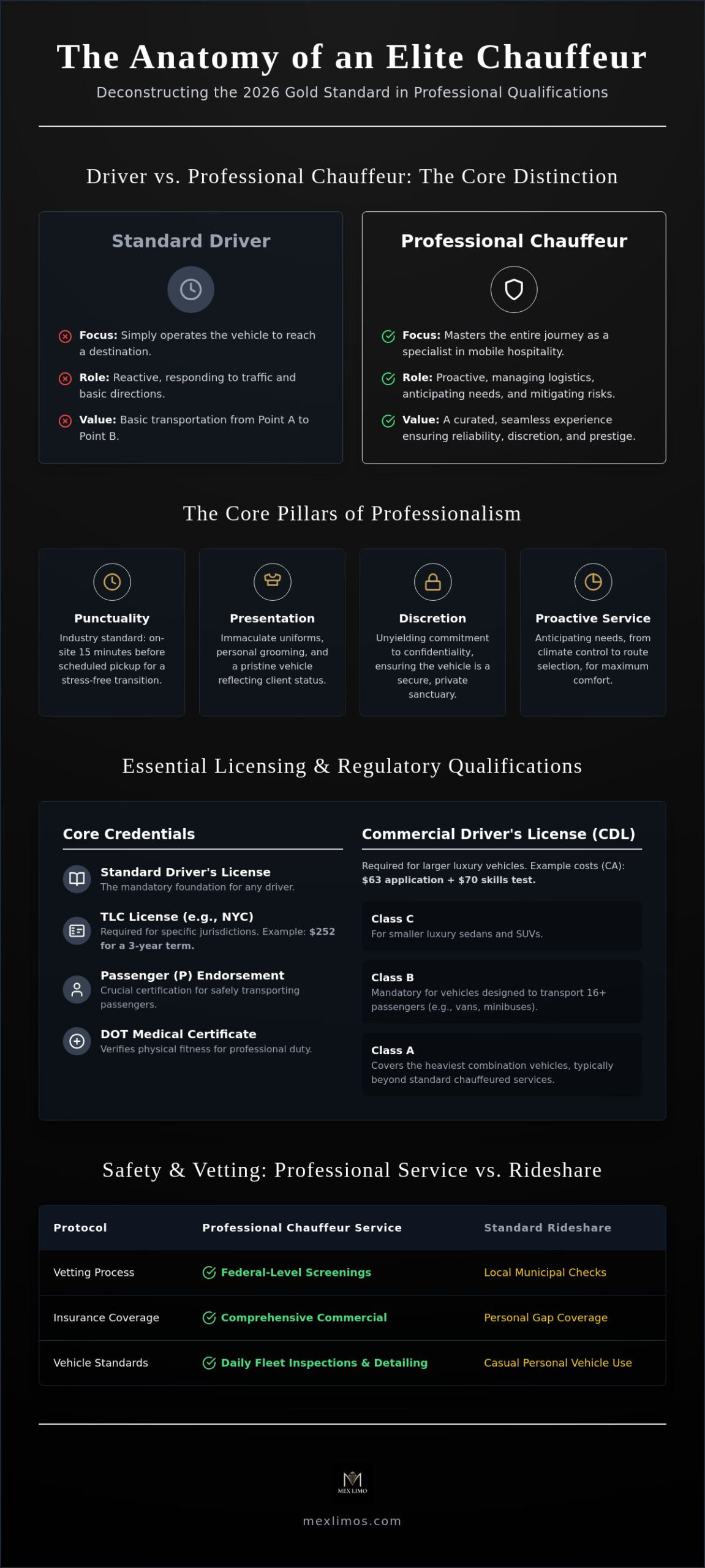
Understanding the fundamental difference between a driver and a chauffeur requires looking beyond the steering wheel. A driver simply operates a vehicle to reach a destination, but a professional chauffeur functions as a specialist in mobile hospitality, risk management, and executive logistics. To truly grasp What is a Chauffeur?, one must appreciate the commitment to service that transforms a commute into a curated experience. While a clean driving record remains the absolute baseline, it’s the specific professional chauffeur training and qualifications that cultivate the discipline required for high-stakes environments.
Reliability is the cornerstone of corporate travel. A minor five-minute delay at an airport transfer can trigger a catastrophic “Domino Effect,” potentially causing a missed connection, a derailed board meeting, or a lost contract. Chauffeurs anticipate these variables by monitoring flight patterns and traffic data in real-time. They operate with an understanding that their performance directly impacts the client’s professional reputation and mental clarity. This high-stakes efficiency is paired with an unwavering commitment to discretion. High-profile clients require a sanctuary, and confidentiality is a core professional requirement. Whether discussing sensitive mergers or preparing for a high-profile wedding, the passenger must trust that the vehicle remains a secure, private environment.
The Core Pillars of Professionalism
Punctuality is a non-negotiable metric for elite service. The industry standard dictates being on-site fifteen minutes before the scheduled pickup time, ensuring a stress-free transition for the passenger. Presentation standards are equally rigorous, involving immaculate uniforms, impeccable personal grooming, and a vehicle aesthetic that reflects the client’s status. This shift from reactive driving to proactive passenger management means the chauffeur anticipates needs, from climate control preferences to the quietest routes through a city. Every detail is managed with quiet confidence and prestige.
Chauffeur vs. Rideshare: A Safety Comparison
Rideshare platforms often rely on local municipal background checks, but professional chauffeur training and qualifications demand a deeper level of vetting. This process frequently includes federal-level screenings and more stringent drug testing protocols. Professional services carry comprehensive commercial insurance rather than relying on the precarious personal gap coverage typical of the gig economy. Vehicle inspection rigor also follows a higher standard. Fleet maintenance involves daily mechanical inspections and professional detailing that far exceed the casual requirements of a personal vehicle. This disciplined approach ensures that every journey is safe, predictable, and exceptionally comfortable.
Essential Licensing and Regulatory Qualifications
Entering the upper echelons of the livery industry requires more than a casual aptitude for driving. It demands a structured adherence to legal frameworks that prioritize passenger safety and operational integrity above all else. While a standard driver’s license serves as the necessary foundation, the pursuit of elite professional chauffeur training and qualifications quickly moves into specialized territory. For those operating within major transportation hubs like New York City, maintaining a valid TLC license involves specific fees, currently set at $252 for a three-year term as of July 2026, alongside mandatory education and defensive driving courses.
To meet these high expectations, many aspiring professionals in the Westchester and New York regions explore Driving Instruction and Certification Courses to refine their technical skills and build the confidence necessary for elite chauffeuring.
The transition to larger luxury vehicles, such as passenger vans or stretch limousines, necessitates a Commercial Driver’s License (CDL). In California, the base application for a Class A or B CDL in 2026 is $63, with an additional skills test fee of $70. These classifications are not interchangeable, and selecting the correct one is vital for fleet compliance. A Class C CDL is often sufficient for smaller luxury sedans and SUVs, but once a vehicle is designed to transport 16 or more passengers, a Class B license becomes mandatory. Central to this process is the Passenger (P) endorsement. This specific certification ensures the operator is well-versed in the unique physics, emergency protocols, and safety requirements of high-capacity transport. To complement these licenses, a DOT Medical Examiner’s Certificate is required to verify that the chauffeur possesses the physical fitness, vision, and hearing necessary for long-duration duty.
For travelers navigating the specific regulatory and logistical environment of Southern California, LA Confidential Car Service provides a prime example of how these rigorous licensing standards translate into superior executive transportation.
Navigating CDL Classifications
Chauffeurs must understand the nuances of vehicle weight and capacity to remain legally compliant. Class A covers the heaviest combinations, while Class B is the standard for large buses and specialized livery vehicles. Obtaining these credentials in 2026 involves a multi-stage process of written exams and practical assessments. To ensure you are meeting the highest tier of Advanced Safety Certifications, you should always verify local state mandates against federal requirements.
Regulatory Compliance and Background Vetting
The Federal Motor Carrier Safety Administration (FMCSA) has intensified its oversight for 2026. As of March 16, 2026, non-domiciled CDL holders must possess a valid H-2A, H-2B, or E-2 visa to maintain their eligibility. Additionally, the FMCSA now strictly enforces English language proficiency, requiring drivers to communicate fluently with law enforcement and read all regulatory signage. Beyond these legal hurdles, professional firms implement random drug and alcohol testing and annual Motor Vehicle Record (MVR) reviews. This layered approach to vetting ensures that every corporate chauffeured journey is managed by an individual of impeccable character and physical fitness.
Advanced Safety and Defensive Driving Certifications
While regulatory compliance establishes a legal baseline, the elite tier of the industry is defined by specialized safety protocols that transcend standard traffic laws. The 2026 industry standard for professional chauffeur training and qualifications places a heavy emphasis on advanced hazard perception and evasive maneuvering. These are not merely suggestions; they are rigorous disciplines designed to protect high-profile passengers in unpredictable environments. Aspiring professionals often begin their journey by consulting the FMCSA Training Provider Registry to ensure their foundational entry-level driver training meets federal requirements, but the true refinement happens through luxury-specific defensive driving courses.
A professional must possess the ability to identify potential threats before they materialize. This involves mastering the unique physics of a luxury sedan or a high-capacity SUV, which respond differently than standard commuter vehicles under duress. Beyond physical vehicle control, route planning has evolved into a sophisticated blend of technological data and human intuition. Over-reliance on GPS is a common pitfall that true professionals avoid. While digital tools provide a framework, a chauffeur’s local expertise allows them to bypass construction zones or sudden congestion that automated systems might miss, ensuring that a journey remains perfectly on schedule regardless of external variables.
Mastering the Vehicle and the Road
Understanding vehicle dynamics is essential when managing the substantial weight and length of a stretch limousine. Braking distances are significantly extended, requiring a chauffeur to maintain a larger safety cushion and employ smoother deceleration techniques to preserve passenger comfort. During winter months, adverse weather protocols become paramount. This includes specialized training in skid recovery and the precise application of traction control systems to navigate icy conditions without compromising the “Safety First” culture. Rigorous pre-trip and post-trip inspections ensure that every vehicle in the fleet remains in peak mechanical condition, preventing mid-journey failures and maintaining the brand’s reputation for reliability.
Technological Proficiency
The modern chauffeur acts as a logistics manager as much as a driver. Utilizing advanced dispatch software, they coordinate seamless pickups by integrating real-time flight tracking and traffic data. This allows for immediate alternate route selection when unexpected delays occur. Beyond navigation, technical proficiency extends to the cabin environment. Chauffeurs are trained to manage complex in-vehicle amenities, from personalized climate control zones to secure Wi-Fi configurations, ensuring the vehicle serves as a productive mobile office or a tranquil sanctuary for leisure travelers. This intersection of modern efficiency and classic hospitality is what separates a certified professional from a standard driver.
The Art of Service: Hospitality and Etiquette Training
While technical skills and licenses form the backbone of the industry, the soul of the profession lies in hospitality. The 2026 standard for professional chauffeur training and qualifications emphasizes that a journey is a sensory experience, not just a transfer. This begins with the “Meet and Greet” protocol at major terminals like JFK or EWR. A professional stands at a designated location with a clear, digital sign, offering a reassuring presence amidst the chaos of travel. From that first interaction, the chauffeur assumes responsibility for the client’s ease, providing seamless door service and meticulous handling of luggage. This includes not just lifting bags, but ensuring they are placed securely and handled with the utmost care.
Communication is a refined skill that requires constant adjustment. A chauffeur must gauge the passenger’s mood instantly through verbal and non-verbal cues. High-profile clients often require absolute anonymity and a quiet environment to conduct business or rest. Knowing when to engage in polite, brief conversation and when to provide respectful silence is a hallmark of elite training. Discretion is not merely a preference; it is a professional mandate that ensures the vehicle remains a private sanctuary. Every interaction is designed to make the passenger feel prioritized and cared for, long before they reach their final destination.
Executive Interaction and Protocol
Mastering professional phrasing involves using language that conveys respect without being subservient. During complex multi-stop itineraries, such as corporate roadshows, the chauffeur acts as an on-site coordinator who remains unruffled by schedule changes. They anticipate needs before they are voiced, ensuring the cabin is stocked with chilled water, compatible device chargers, and the passenger’s preferred climate settings. This proactive approach minimizes friction and allows the executive to focus entirely on their objectives. The ability to remain a calm, steady partner in a high-stakes environment is what separates a true professional from a standard driver.
The Visual Standard: Vehicle Preparation
The aesthetic of the vehicle must be as polished as the chauffeur’s conduct. Interior detailing occurs before every trip, ensuring a pristine environment free of debris or distracting scents. Chauffeurs stock amenities based on the specific event type. For instance, a celebratory occasion like a graduation requires a different set of preparations than a standard airport run. Aroma and temperature management are handled with precision to create a sensory luxury experience that begins the moment the door is opened. To experience this level of curated care first-hand, you can book a professional chauffeur for your next high-profile engagement.
Why Mex Limo Prioritizes Certified Excellence
Since our founding in 2009, Mex Limo has operated with the firm conviction that elite transportation is a promise of reliability, punctuality, and grace. While the 2026 industry shifts have forced many providers to re-evaluate their protocols, our commitment to professional chauffeur training and qualifications remains the definitive cornerstone of our legacy. We don’t just provide transport; we offer a sophisticated, stress-free partnership for clients who understand that their choice of vehicle reflects their personal and professional status. By prioritizing a standard of conduct that goes beyond simple task fulfillment, we ensure that every journey is a seamless extension of your high-stakes lifestyle.
Our diverse fleet, ranging from luxury sedans and SUVs to stretch limousines and passenger vans, is managed with a meticulous attention to detail that mirrors the expectations of a premium concierge. We recognize that the value of your time is absolute. Whether you’re coordinating complex corporate logistics or indulging in a celebratory night on the town, our team provides a steady, rhythmic experience that removes the friction from travel. This dedication to excellence allows our passengers to remain unruffled and focused, knowing they are in the hands of a trusted partner who maintains constant availability and total commitment to their safety.
The Mex Limo Vetting Process
Safety is not a static achievement, but a continuous discipline of monitoring and improvement. Our vetting process involves strict background checks that exceed standard municipal requirements, paired with continuous performance monitoring to maintain our high standards. Chauffeurs receive ongoing training in the most current safety and hospitality protocols, ensuring they are well-versed in the 2026 landscape of risk management and executive etiquette. This focus on professional rigor ensures that every stylish and punctual arrival is backed by a foundation of verified expertise. We don’t settle for baseline drivers; we cultivate specialists who are deeply reliable and attentive to the nuances of luxury travel.
Your Seamless Travel Partner
From high-stakes airport transfers at JFK, LGA, and EWR to the refined atmosphere of wedding limousine services, we maintain a singular, global standard of excellence. Our professionals utilize real-time flight tracking and advanced logistics tools to anticipate your needs, providing professional meet-and-greet options that ensure a smooth transition from the terminal to the cabin. We understand that a corporate roadshow or a cruise terminal transfer requires precision and discretion. By integrating modern efficiency with classic high-end hospitality, we provide a travel experience that respects your privacy and enhances your productivity. Experience the difference of a professional chauffeur with Mex Limo.
Elevate Your Standard of Travel
Securing elite transportation in 2026 requires looking beyond the vehicle to the professional at the wheel. The distinction between a driver and a chauffeur is found in an unwavering commitment to mobile hospitality, rigorous safety protocols, and absolute discretion. By understanding the complexity of professional chauffeur training and qualifications, you’re empowered to choose a partner that values your time as much as your security. Whether you require a seamless airport transfer or a coordinated corporate roadshow, the standard of care should remain unruffled and absolute.
Mex Limo has been serving discerning clients since 2009, providing a diverse fleet of luxury sedans and SUVs managed by a 24/7 professional dispatch team. We invite you to move past the uncertainty of standard driving services and embrace a journey defined by quiet confidence and prestige. Every detail is handled with precision; this ensures your arrival is as stress-free as it is elegant. Your status deserves a travel partner that never settles for anything less than excellence.
Book Your Professional Chauffeur Service Today and experience the difference that over a decade of disciplined service brings to your next destination.
Frequently Asked Questions
What is the primary difference between a driver and a chauffeur?
The primary difference lies in the level of specialized service and professional discipline. While a driver simply operates a vehicle to reach a destination, a chauffeur is a specialist in mobile hospitality and risk management. This role requires mastering executive protocol, maintaining absolute discretion, and ensuring a pristine environment. Chauffeurs are trained to anticipate passenger needs and manage complex logistics, transforming a simple commute into a curated, stress-free experience.
Do chauffeurs need a special license for airport transfers?
Yes, chauffeurs often require specific municipal licenses or airport permits to conduct transfers at major transportation hubs. For example, operating at JFK or LGA requires a valid TLC license in New York, which involves specific fees and background checks. These regulations ensure that the operator meets local safety standards and possesses the necessary insurance, providing a level of security that standard driving licenses don’t offer for high-stakes travel.
What certifications are most respected in the chauffeuring industry?
The most respected certifications include the PAX Professional Chauffeur Standards and programs endorsed by the National Limousine Association. These certifications cover defensive driving, VIP protocol, and client confidentiality. Holding these credentials demonstrates a commitment to professional chauffeur training and qualifications that exceed basic legal requirements. This ongoing education ensures every journey is managed with the precision and grace expected by high-profile corporate and leisure travelers alike.
How often do professional chauffeurs undergo training?
Professional chauffeurs typically engage in ongoing training with formal reviews conducted at least once per year. This education includes defensive driving refreshers, updates on the latest vehicle technology, and hospitality workshops. Continuous training ensures that the chauffeur remains adept at handling evolving traffic laws and the sophisticated amenities found in modern luxury fleets. This disciplined approach to education is what maintains the high standard of reliability and safety within the elite transport sector.
Is a CDL always required to drive a limousine?
A Commercial Driver’s License (CDL) isn’t always required; it depends on the vehicle’s passenger capacity and weight. In the United States, a CDL with a Passenger (P) endorsement is mandatory for any vehicle designed to transport 16 or more people, including the driver. For standard luxury sedans and SUVs, a high-tier chauffeur license and a clean motor vehicle record are often sufficient to meet the industry standards for professional operation.
What soft skills are most important for a professional chauffeur?
Discretion and refined communication are the most vital soft skills for a professional in this field. A chauffeur must possess the emotional intelligence to gauge when a passenger requires silence for business or engagement for hospitality. Punctuality, poise under pressure, and an intuitive ability to anticipate needs define the elite service standard. These skills allow the chauffeur to act as a trusted partner who remains unruffled regardless of the complexity of the itinerary.
How does Mex Limo ensure the quality of its chauffeurs?
Mex Limo ensures quality through a rigorous vetting process that includes federal background checks and continuous performance monitoring. Since our founding in 2009, we’ve prioritized a culture of professional rigor and 24/7 reliability. Our chauffeurs are trained in the latest safety standards and hospitality protocols to maintain our legacy of excellence. This disciplined approach guarantees that every client receives the attentive, seamless experience they expect from an elite, seasoned concierge service.
Can a chauffeur help with luggage and airport check-in?
A chauffeur provides comprehensive assistance with luggage as a standard part of their hospitality service. While they generally don’t handle the formal airline check-in process, they offer expert guidance at the terminal and ensure a seamless transition to the curbside. This level of care allows the passenger to remain unruffled while navigating busy transportation hubs. By managing the physical logistics of the luggage, the chauffeur ensures the client can focus entirely on their upcoming journey.