
Imagine your airport transfer arrives later than planned, but the chauffeur communicates clearly and handles the rest of the journey with care. How you describe both parts of that experience matters. Providing feedback to a limo company is most useful when you connect specific details, such as timing, communication, or chauffeur professionalism, to a clear and reasonable suggestion.
You may wonder which details to include, how to raise a concern without sounding accusatory, or whether a private message is better than a public review. A calm, factual account helps the company understand what happened and respond constructively, while also recognizing what went well.
This guide explains how to organize your feedback, choose an appropriate channel, and make a complaint clear, fair, and actionable. You’ll learn when to contact the company directly, when a public review may be appropriate, and when a serious safety concern may call for a formal complaint. Whether your trip involved an airport transfer, corporate travel, or a special event with a chauffeured service such as Mex Limo Worldwide Chauffeured Service, thoughtful feedback can help inform a more polished experience for future passengers.
Key Takeaways
- Useful feedback describes what happened and why it mattered, without relying on assumptions or blame.
- Include trip details such as the date, booking reference if available, service type, and relevant stage of the journey.
- Choose a private message or public review based on your purpose, privacy needs, and intended audience.
- When providing feedback to a limo company, state a clear, reasonable improvement that could help future passengers.
- If your concern remains unresolved, allow reasonable time, follow up once, and restate the outcome you’re seeking.
Why providing feedback to a limo company can improve the next journey
Sharing feedback after an important or stressful trip can feel awkward. You may worry that a concern will sound emotional or that a compliment won’t be useful. Yet providing feedback to a limo company can turn your experience into information the company can consider when refining its service.
Useful feedback describes what happened and why it mattered. “The pickup was disappointing” offers little to investigate. “I waited at the agreed pickup point but didn’t receive an update about the delay” identifies a specific moment and a communication gap. A complaint resolution system gives organizations a way to receive and address concerns, but the details you share help make your individual report understandable.
A balanced account can recognize what went well while identifying a realistic improvement. For example, you might note that a chauffeur was courteous while explaining that an unclear pickup update made it difficult to know where to meet. This gives the company a fuller picture than praise or criticism alone, without requiring you to soften a genuine concern.
Consider your intended audience. Direct feedback is generally suited to helping the company understand your experience and consider a service improvement. A public review is written for prospective customers, so it can describe what they may want to know. Avoid including private details about other passengers or your itinerary. The two channels serve different purposes, and one does not necessarily replace the other.
When is the right time to share feedback?
Write down key details soon after the trip, while the sequence of events is still clear. You don’t have to send your message right away. If you’re upset, take time to review your notes and choose measured wording. For an urgent safety concern or a time-sensitive issue, use an appropriate direct channel promptly rather than waiting to write a full account.
What makes feedback constructive rather than simply critical?
Connect your observation to an identifiable moment, action, or communication, then explain its effect on you as a passenger. Avoid guessing why someone acted as they did. For instance, describe how an unclear update affected your pickup plans instead of claiming the chauffeur intended to leave you waiting. Where appropriate, add a practical request, such as clearer arrival updates, or suggest a reasonable improvement. Specific details make your concern easier to understand and respond to, while a measured tone keeps the focus on the journey and what could be better.
What to include when providing feedback to a limo company
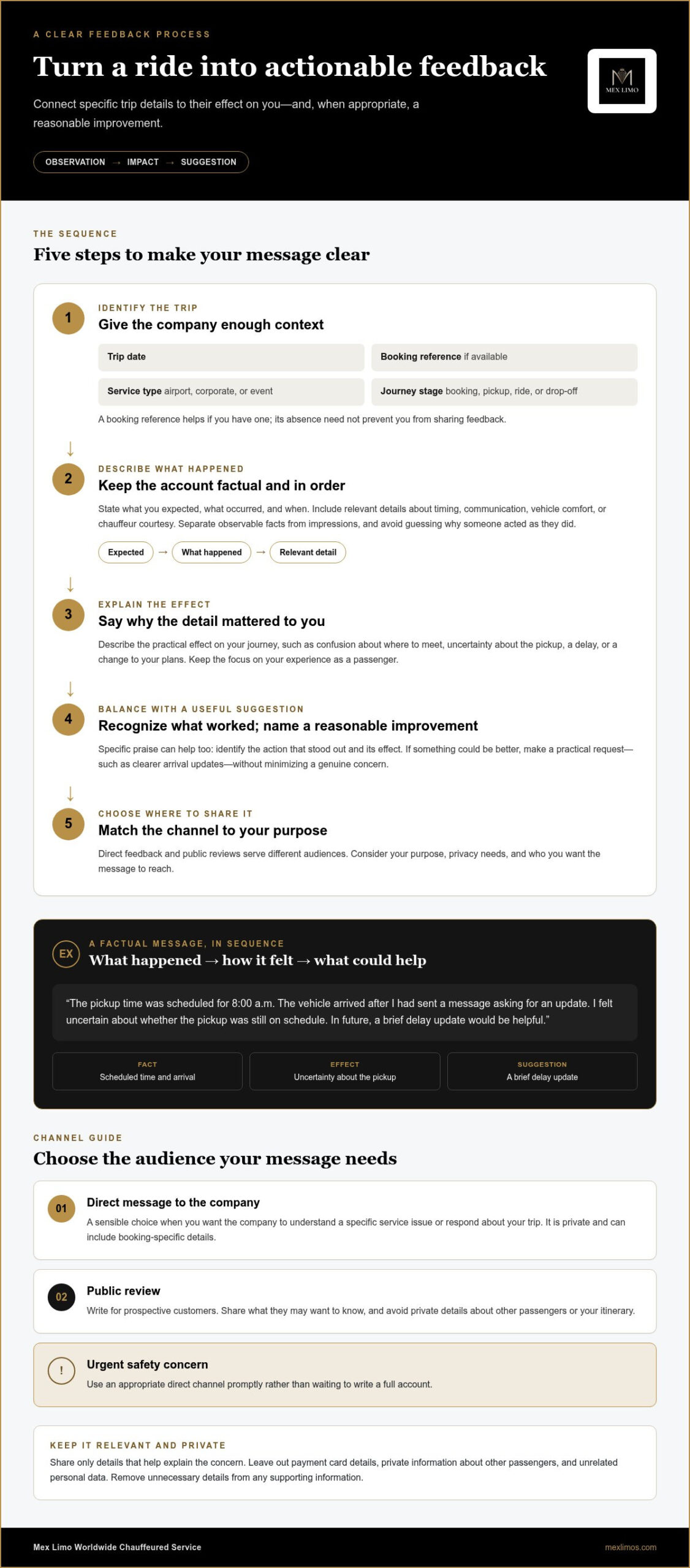
A concise, well-organized message makes it easier to identify the trip and understand which part of the experience you’re describing. Start with the essentials, then add only the details that help explain what happened. A booking reference is useful if you have one, but don’t delay sharing feedback just because you can’t find it.
- Trip date and booking reference, if available
- Service type, such as airport transfer, corporate travel, or event transportation
- Journey stage, such as booking, pickup, the ride, or drop-off
- Relevant details about timing, communication, vehicle comfort, or chauffeur courtesy
Keep observable facts separate from your impressions and requests. For example: “The pickup time was scheduled for 8:00 a.m. The vehicle arrived after I had sent a message asking for an update. I felt uncertain about whether the pickup was still on schedule. In future, a brief delay update would be helpful.” This sequence distinguishes what you observed, how it affected you, and what change you’re suggesting.
Share only what’s relevant. Avoid payment card details, private information about other passengers, and unrelated personal data. If you include a message or other supporting information, remove details that aren’t needed to understand the concern.
How should you describe a specific problem?
Describe events in chronological order and use neutral language. State what you expected, what happened, and the practical effect, such as confusion, a delay, or a change to your plans. Include supporting details only when they clarify the issue and are appropriate to share. Stick to what you know rather than guessing why a delay or communication gap occurred.
How can you recognize excellent service?
Specific praise is just as useful as a concern. Name the action that stood out, then explain its effect. During an airport transfer, for example, clear pickup instructions may have made it easier to meet the chauffeur after landing. For corporate or event transportation, you might describe courteous assistance that helped the journey feel composed and well organized.
Thoughtful details give a company a clearer picture than broad comments such as “great service” or “poor experience.” Whether you’re describing punctuality, communication, comfort, or professional conduct, the goal of providing feedback to a limo company is to make your experience understandable and your point actionable. For context on the journey itself, you can review Mex Limo’s chauffeured transportation services.
Which feedback channel and tone should you choose?
The right channel depends on what you want your message to accomplish. Direct feedback is private and can include booking-specific details, making it a sensible choice when you’re seeking a response about a particular service issue. A public review speaks to future passengers instead. It can offer a useful overview of your experience, but it isn’t a private conversation with the company.
For private feedback, use the company’s stated customer-service or booking communication channel. Include enough information to identify the trip, but keep confidential details and other passengers’ personal information out of your message. If you post a review, stick to what you personally experienced and avoid revealing private itinerary or booking information.
When is direct feedback more suitable than a public review?
Choose a private channel if you want to discuss a specific booking, explain a concern in detail, or request a response about an issue. A public review is better suited to a fair account that may help future passengers understand what the service was like. For an urgent safety or time-sensitive concern, communicate promptly through an appropriate direct channel rather than relying on a public post to reach the company.
You can use both channels if each serves a distinct purpose. First raise a booking-specific issue privately, then decide whether a separate, factual review would help other customers. Keep the review focused on your own experience and leave out confidential information, including details about fellow passengers.
How can you keep your wording fair and professional?
First-person language helps show that your account is based on personal experience. “I didn’t receive an update about the pickup delay” is more precise than “The company never communicates.” Describe what you observed, how it affected your trip, and, if appropriate, what would have helped. Avoid insults and speculation about anyone’s intentions.
A composed tone doesn’t mean withholding honest criticism. It means making the criticism clear and proportionate, just as specific praise should name what worked. For instance, you could note that the chauffeur was courteous while explaining that unclear pickup instructions made it harder to coordinate your arrival. That context keeps the account balanced without minimizing the concern.
Whether you’re writing privately or publicly, providing feedback to a limo company is most effective when the channel suits your purpose and the wording stays grounded in firsthand experience. Courtesy and candor can go together: explain the issue plainly, recognize relevant strengths, and protect personal information.
What to do if feedback is ignored or unresolved
It can be frustrating to send a clear message and not receive a response, especially if the issue affected an important trip. A delay or lack of reply doesn’t tell you why your message hasn’t been addressed, so keep the next step measured: allow a reasonable amount of time, then follow up once through the same appropriate channel.
Keep a copy of your original message and any reply, along with relevant booking details. This helps you refer accurately to what you reported and avoids having to reconstruct the conversation. If you shared a public review and the company later resolves the issue, you can update it to reflect what happened next while preserving an honest account of your initial experience.
How should you follow up on an unanswered message?
Keep the follow-up concise and courteous. Refer to your earlier message, identify the service date or booking, restate the central concern, and say what response or resolution you’re seeking. For example: “I’m following up on my note about the pickup for my trip on [date]. Could you let me know how this concern will be addressed?” This makes the next step clear without repeating every detail.
Before sending, check that the message is going to the company’s stated customer-service or booking communication channel. If you still don’t hear back, consider whether a separate formal complaint route is appropriate for the nature of the issue. Direct service feedback and formal complaints can have different purposes, so choose a route that fits the concern rather than escalating automatically.
How can you keep criticism proportionate and credible?
Describe only what you personally experienced and can explain accurately. Avoid repeated messages, threats, or claims that go beyond what you know. Separate one specific concern from your overall assessment. A trip may have included courteous service and a comfortable vehicle, while one communication issue still deserves attention. That distinction keeps your account fair without diminishing the impact of the problem.
If you posted publicly, revise the review if new information changes the picture. You might add that the company responded or explain whether the issue was resolved, while keeping the original events clear. Honest updates help readers understand the full sequence rather than leaving an outdated impression.
A calm follow-up can keep the focus on clarity and resolution. If you’re considering a future chauffeured journey, explore Mex Limo’s chauffeured services and the travel options available for your plans.
Turn a trip experience into feedback a limo company can act on
A simple structure can help you turn a memorable moment, positive or difficult, into feedback that’s easy to understand. Keep the message focused on one or two observations, explain their effect on your journey, and close with a reasonable request or a note of appreciation. This approach works for airport transfers, corporate travel, and event transportation alike.
What is a simple template for useful passenger feedback?
Use this fill-in format as a starting point, then adjust it to reflect your own experience:
- Trip: “On [date], I booked [service type] for [brief journey description].”
- Observation: “I noticed [specific action, event, or communication].”
- Impact: “This affected my trip by [practical effect or positive benefit].”
- Next step: “Could you [reasonable request or improvement]?” or “Thank you for [specific action that helped].”
For example: “On [date], I booked an airport transfer. I received a clear update about the pickup, which made it easier to coordinate where to meet. Thank you for keeping the communication straightforward.” For a concern, describe the moment and impact without adding assumptions: “The vehicle arrived later than the scheduled pickup, and I had less time than planned before my appointment. In future, an update about a delay would help me adjust my plans.”
How does professional service shape the feedback passengers can give?
Professional chauffeured travel involves several parts of the passenger experience. You can comment on punctuality, how clearly trip updates were communicated, the chauffeur’s courtesy, or the vehicle’s comfort. Naming the specific element helps distinguish a one-time issue from an overall assessment and gives context to praise as well as criticism.
A passenger might say a courteous chauffeur made an event transfer feel welcoming, or that a clear update during an airport pickup reduced uncertainty. If comfort was the concern, describe the feature that affected your ride rather than labeling the entire experience. Precise observations help keep feedback fair and useful without suggesting that any particular outcome is guaranteed.
Mex Limo has served passengers since 2009, with professional chauffeurs and a focus on punctuality and communication. To learn more about the company’s approach to chauffeured travel, explore Mex Limo chauffeured services.
Make your next journey better with clear, thoughtful feedback
Providing feedback to a limo company doesn’t need to be complicated. Share the trip details that identify your journey, describe what you observed and how it affected you, then make a practical request if an improvement is needed. Choose a private channel for a booking-specific concern or a public review to give future passengers a fair account. Keep your wording calm, accurate, and respectful.
For your own chauffeured travel, experience and attentive service matter. Mex Limo has served passengers since 2009, with professional chauffeurs, real-time flight tracking, and 24/7 availability supporting its transportation services.
Explore Mex Limo’s chauffeured services for airport transfers, corporate travel, and special occasions. A clear account of what worked well, or what could improve, can help encourage a more polished passenger experience. Your next journey can begin with confidence.
Frequently Asked Questions
How do I provide feedback to a limo company?
Use the company’s stated customer-service or booking communication channel for private feedback, and describe your trip clearly. Include the service date, booking reference if available, and the part of the journey you’re commenting on. State what happened, how it affected you, and what response or improvement you’re seeking. Providing feedback to a limo company in a calm, specific way makes your experience easier to understand without relying on blame or assumptions.
What should I include in a complaint about a limo service?
Include the trip date, booking reference if you have one, service type, and relevant journey stage, such as pickup or drop-off. Describe events in order and separate what you observed from your impressions. For example, note that you didn’t receive a pickup update, then explain how that left you uncertain about where to meet. Add a practical request if appropriate, and leave out payment details and other passengers’ private information.
Should I contact a limo company directly or leave a public review?
Contact the company directly if you want to discuss a specific booking, share details privately, or request a response about an issue. A public review is more suited to a fair account for future passengers. It should reflect your firsthand experience and omit confidential booking or passenger information. For an urgent safety or time-sensitive concern, use an appropriate direct channel promptly rather than relying on a public post to reach the company.
How long should I wait for a limo company to respond to feedback?
There’s no universal response time for direct passenger feedback, so allow a reasonable period based on the nature of your concern and any timeframe the company provides. If you haven’t heard back, follow up once through the same channel, briefly referring to your original message and restating what you’re asking for. Keep a copy of your correspondence and relevant booking details. Avoid assuming that silence means your concern has been dismissed.
Can I give feedback about a chauffeur by name?
Yes, if you know the chauffeur’s name and it helps the company identify the trip or understand your feedback. In a private message, include the name only alongside relevant details, such as the service date and journey stage. Focus on specific conduct, such as courteous assistance or unclear communication, rather than personal judgments. In a public review, consider whether naming the chauffeur is necessary, and don’t share private information.
Is it better to give positive feedback privately or publicly?
Either can be appropriate, depending on your purpose. A private message lets the company know directly which action you appreciated, such as a clear pickup update or courteous assistance. A public review can help future passengers understand what worked well during your trip. You can do both, but keep a public post focused on your firsthand experience and avoid disclosing private itinerary or passenger details.
What happens if a limo company does not resolve my complaint?
If your concern remains unresolved after a reasonable wait and one courteous follow-up, keep your account and correspondence together. You may consider a relevant consumer organization or regulatory authority, particularly for a serious safety concern. The appropriate route depends on the issue and location. If you posted a public review, you can update it if circumstances change. Keep any update factual, proportionate, and clear about what was or wasn’t resolved.