
What if the policy that meets a legal minimum still leaves a limo company exposed to a costly claim? Commercial auto coverage is central to passenger transportation, but it may not address every risk involving employees, business property, or vehicle use. Understanding what insurance should a limo company have starts with its actual operations, not a one-size-fits-all checklist.
Requirements can vary by location, vehicle capacity, and services provided. A company may also consider protection beyond what regulations require. A sedan handling airport transfers, an SUV carrying corporate clients, and a stretch limousine booked for a celebration can each involve different operating exposures.
This guide explains common policies limousine businesses evaluate, including commercial auto, general liability, workers’ compensation, and hired and non-owned auto coverage. It also outlines what to review about business activities and how to describe insurance documents accurately to clients. The goal is to make a coverage review more practical without mistaking one policy for complete protection.
Key Takeaways
- Think of limo insurance as a coordinated set of policies, not a single policy expected to address every business exposure.
- To decide what insurance should a limo company have, start with its vehicles, drivers, passenger services, employment arrangements, and business locations.
- Distinguish vehicle-related coverage from policies that may address other business activities, premises, or employee-related risks.
- Compare airport transfers, corporate bookings, weddings, and events to identify exposures that a general checklist could overlook.
- Review applicable rules and policy documents, record key coverage details accurately, and revisit the assessment when operations change.
What Insurance Should a Limo Company Have, and Why Does Coverage Matter?
To answer what insurance should a limo company have, look at the whole operation, not just the vehicles. An insurance program is a set of policies that may address different transportation and business exposures. The right mix depends on how the company operates, the vehicles and people involved, and applicable requirements.
Passenger transportation involves more than owning and maintaining a vehicle. A paid trip puts a professional driver and passengers on the road, while bookings may also involve pickup and drop-off activity, employees, business premises, or arrangements with other parties. For each part of the operation, ask who or what is covered, under which policy, and subject to what exclusions or limits. Don’t assume one policy addresses every exposure.
Commercial auto insurance is coverage designed for vehicles used in business, including liability arising from covered vehicle-related accidents, subject to the policy’s terms. This doesn’t mean every business liability, employee injury, or property loss is covered by commercial auto insurance.
How is a chauffeured transportation business different from a private vehicle owner?
A personal vehicle is generally used for private purposes, while a chauffeured vehicle carries passengers as part of a paid business operation. The purpose and pattern of vehicle use matter. A personal auto policy may treat business use differently, so an operator shouldn’t assume coverage intended for private driving automatically applies to commercial passenger transportation. The policy wording and declared vehicle use are central.
Trip types also shape the exposure. An airport transfer may involve scheduled pickups and drop-offs; an hourly booking can mean extended time on the road; a wedding may require coordinated passenger transport around an event; and a concert or other event trip may involve busy arrival and departure periods. These examples don’t determine coverage, but they help an operator describe actual activities during a policy review. The same fleet can be used in different ways, so coverage should be considered in light of those uses.
Are required insurance and recommended coverage the same thing?
No. Legal requirements set a compliance baseline, while risk-management decisions consider whether additional coverage is appropriate for the company’s financial exposures. Requirements can vary by jurisdiction and may depend on factors such as vehicle type, passenger capacity, service, and operating arrangement. A rule that applies to one operation may not apply to another.
Before relying on a legal minimum, verify current requirements with the relevant government or regulatory authority for each place and operation involved. Rules and limits can change, so check jurisdiction-specific requirements against current official information. Compliance alone doesn’t establish that a business has addressed every exposure it wishes to manage.
A practical review separates required coverage from optional protection, then compares each policy’s scope, exclusions, and limits with actual operations. This helps a limo company make informed decisions without treating a familiar policy name as a promise of complete protection.
Which Insurance Policies Can Protect a Limo Company’s Core Operations?
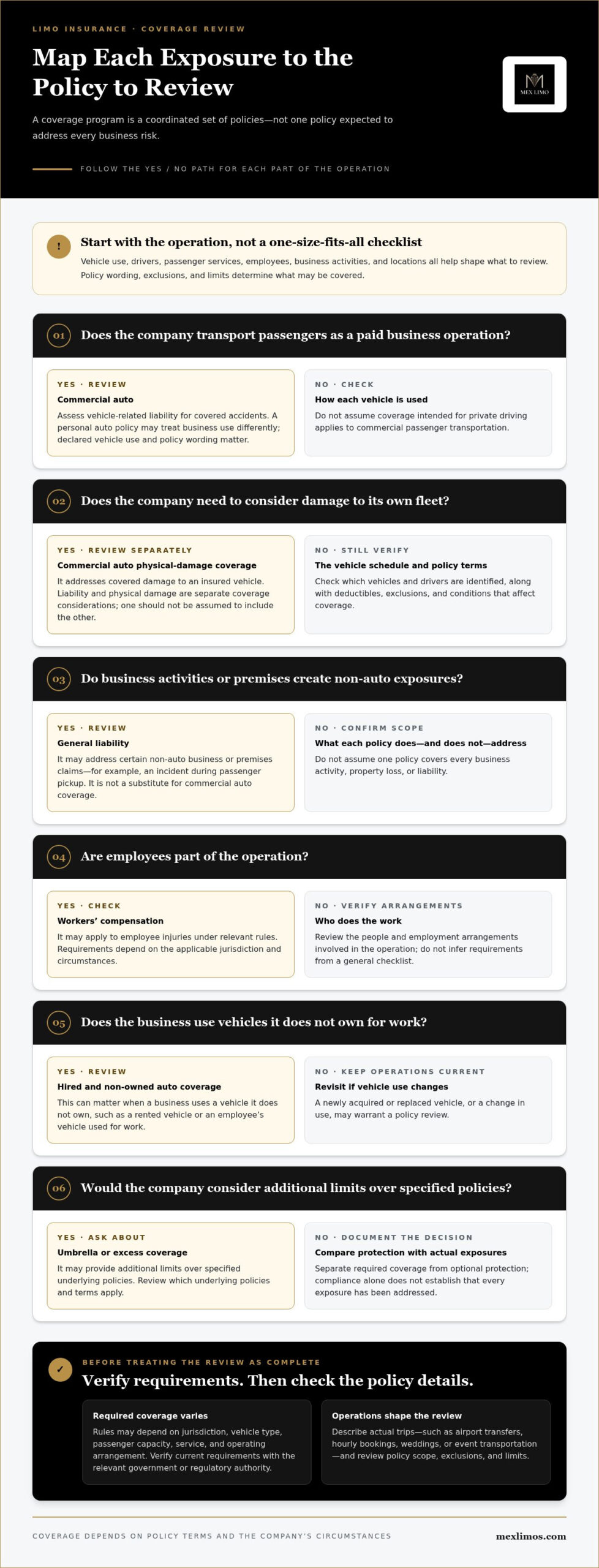
There isn’t one universal package for every limousine business. To determine what insurance should a limo company have, map coverage options to the operation: vehicles in service, people doing the work, and activities that take place away from the road. Policy names are a starting point; wording, exclusions, limits, and the company’s circumstances determine what a policy may address.
Commercial auto is the vehicle-focused foundation to assess. General liability may address certain non-auto business claims, while workers’ compensation may apply to employee injuries under relevant rules. Umbrella or excess coverage may provide additional limits over specified underlying policies. Hired and non-owned auto coverage can also matter when a business uses vehicles it doesn’t own, such as a rented vehicle or an employee’s vehicle used for work. Each option depends on its terms and how the business operates.
What does commercial auto insurance address?
Commercial auto liability addresses covered vehicle-related injury or property-damage claims; physical-damage coverage addresses covered damage to an insured vehicle. These are separate coverage considerations, and one shouldn’t be assumed to include the other. A company may review liability protection for vehicles used to transport passengers and separately consider coverage for damage to its own fleet.
Details matter. A policy may identify particular vehicles and drivers, set deductibles, and describe exclusions or conditions that affect coverage. For an operator with sedans, SUVs, and stretch limousines, reviewing the vehicle schedule helps ensure the documents reflect the fleet in use. A newly acquired or replaced vehicle, or a change in how a vehicle is used, may warrant a policy review.
When might general liability, workers’ compensation, or umbrella coverage matter?
Not every business exposure happens during a drive. General liability may be relevant to certain claims involving business activities or premises, such as an incident during passenger pickup, but it isn’t a substitute for commercial auto coverage. The policy wording determines which claims it addresses and which exclusions may apply.
Employee arrangements deserve a separate review. Workers’ compensation may address work-related employee injuries, and applicable requirements vary by jurisdiction and employment circumstances. Verify current rules with the relevant official authority rather than relying on a broad rule of thumb. If drivers are subcontractors, or employees use personal or rented vehicles for business tasks, clarify how those arrangements are treated across the relevant policies.
Umbrella or excess coverage may add limits above certain underlying policies, but it doesn’t automatically broaden every form of protection. Confirm which policies it sits over, what conditions apply, and whether exclusions affect the exposure you intend to address. A business owner’s policy may combine general liability and commercial property coverage, though its suitability depends on the operation and policy terms.
A useful review connects each policy to a defined exposure instead of collecting familiar policy names without understanding their roles. For a sense of the varied passenger trips a chauffeured business may handle, explore airport and event transportation services.
Why One Limo Insurance Policy May Not Address Every Business Exposure
A limousine trip involves more than a vehicle moving between two points. The company’s role, the driver, the passenger arrangement, and what happens at pickup or drop-off can all shape the exposures to review. Commercial auto coverage is important, but its name alone doesn’t establish that every business-related claim falls within its scope. Use the table below to map activities to questions. It’s a starting point, not a declaration that a particular policy will cover a loss.
| Business activity | Possible exposure | Coverage category to discuss | Questions to investigate |
|---|---|---|---|
| Airport transfer | Vehicle damage, passenger injury, or damage to another person’s property during a trip or pickup | Commercial auto liability and physical-damage coverage | Are the vehicle and driver reflected in the policy, and what limits, deductibles, or exclusions apply? |
| Corporate booking | A company-owned vehicle, an employee’s work activity, or use of a vehicle not owned by the operator | Commercial auto, workers’ compensation, and possibly hired or non-owned auto coverage | How does the policy treat the employment arrangement and any business use of rented or employee-owned vehicles? |
| Wedding transportation | Multiple scheduled pickups, passenger movement around an event, or an incident involving business activity away from the vehicle | Commercial auto and, where relevant, general liability | Which activities and locations fall within the policy terms, and are any exclusions relevant? |
| Event or hourly service | Extended driving, changing stops, employee duties, or third-party property exposure | Commercial auto and other liability coverage appropriate to the activity | Does the described business use match the actual service, and what limits and conditions apply? |
How can trips, events, and passenger arrangements change the risk picture?
A point-to-point transfer may have a different pattern of use than an hourly booking, while multi-stop event transportation can involve repeated pickups and changing locations. Consider each exposure separately: damage to the limousine, injury to a passenger, an employee’s activity, and damage to third-party property are distinct risks. These scenarios are prompts for review, not promises of coverage. Actual policy language and endorsements determine how a claim may be treated.
What exclusions and limits deserve close attention?
A limit is the maximum amount a policy may pay for a covered claim under its terms; an exclusion identifies circumstances or losses the policy doesn’t cover. A deductible is the amount the insured may need to pay toward a covered loss. Check who qualifies as an insured or covered driver, which vehicles are listed, and whether hired or non-owned auto coverage addresses relevant business vehicle use.
Some liability policies are claims-made or occurrence-based. Generally, a claims-made form responds to claims first made during the policy period, subject to its reporting terms; an occurrence form generally focuses on when the event causing the claim happened. Confirm the actual wording, including reporting conditions, rather than assuming the label settles the question. This comparison helps clarify what insurance should a limo company have for its operations without mistaking one policy for a complete safety net.
How to Review a Limo Company Insurance Plan Step by Step
A useful insurance review begins with an accurate picture of the operation, then compares it with policy documents and applicable requirements. This turns the question of what insurance should a limo company have into a practical review rather than a search for a standard package. Keep a written record of findings, unanswered questions, and changes that need follow-up.
What information should an operator assemble for a coverage review?
Build one current inventory before reviewing the policies. Include each vehicle’s type and ownership or leasing status, driver roles, employment or subcontractor arrangements, passenger services, business locations, and patterns of business use. Note airport transfers, corporate travel, weddings, and event trips, including changes to how or where vehicles are used.
- Document the operation. List sedans, SUVs, stretch limousines, and any other vehicles used for business, along with who owns or leases them and who drives them. Include rented or employee-owned vehicles used for business tasks.
- Gather the records. Assemble current policy documents, declarations pages, vehicle schedules, endorsements, certificates of insurance, renewal dates, and available claims history. A certificate may summarize information, but the policy wording is important for understanding terms and exclusions.
- Record service and staffing details. Describe passenger services, driver duties, employee and subcontractor roles, and the locations where business activities occur. Note upcoming changes, such as adding a vehicle, changing a service format, or adjusting driver arrangements.
Scheduled vehicles and authorized drivers should reflect actual operations, because a mismatch can raise questions about how the policy applies. Keep records current, but don’t treat this check as a conclusion about whether a particular claim would be covered.
How can companies spot gaps without assuming coverage?
Compare the inventory with each policy. Check that the named insured, covered autos, driver definitions, and policy dates correspond to the business as it operates. Then examine limits, exclusions, endorsements, deductibles, and how separate policies may interact. Don’t treat a certificate or familiar policy title as proof that a specific activity is covered.
- Flag vehicles or driver arrangements that don’t appear to match the relevant schedules or definitions.
- Compare actual services and locations with the uses described in the policy documents.
- Note unclear exclusions, overlapping provisions, or exposures that may not have an obvious policy match.
- Track upcoming renewals and operational changes so the review can be revisited in a timely way.
Take questions about policy wording to a qualified insurance professional, and verify applicable requirements with the relevant regulator where appropriate. Ask for explanations tied to the written terms, then document what was reviewed and any decisions or follow-up actions. For a closer look at chauffeured travel options, explore professional transportation services.
What Responsible Insurance Planning Means for a Professional Limo Service
Responsible insurance planning is an ongoing business practice, not a one-time search for a definitive policy list. To answer what insurance should a limo company have, document its activities, verify applicable rules, compare those activities with current policy documents, and revisit the review when vehicles, drivers, services, or locations change. This process supports careful administration, but it can’t guarantee how a future claim will be handled.
For Mex Limo Worldwide Chauffeured Service, airport transfers, corporate travel, weddings, and special events illustrate the range of chauffeured transportation. The business has operated since 2009, and its sedan, SUV, and stretch limousine fleet make an accurate record of vehicles and services especially relevant. These operational details don’t indicate which insurance policies or protections the company carries.
How should a company communicate insurance information responsibly?
Proof of insurance documents may provide evidence of insurance at a point in time, but they don’t guarantee that a particular future claim will be covered or that a passenger will have a particular outcome. Keep certificates and customer-facing statements consistent with current policy documents. Don’t quote limits, policy names, endorsements, or coverage assurances unless they’ve been verified against the applicable records.
Clear communication protects trust. If a certificate is requested, use accurate, current documentation and describe it without overstating what it establishes. Policy terms, exclusions, and conditions matter; a short summary shouldn’t be presented as a promise that every trip or circumstance is covered.
How does careful planning support a polished passenger experience?
Well-organized operations help a chauffeured business prepare for the details behind a smooth journey: vehicle assignments, driver roles, pickup plans, and changing schedules. Those practices don’t replace insurance review, but they support dependable administration across airport transfers, executive travel, wedding transportation, and event trips. For distinct service considerations, explore the corporate chauffeured travel guide and wedding limousine services guide.
A concise action plan keeps the work manageable:
- Document vehicles, drivers, employment arrangements, services, and business locations.
- Review current requirements with the relevant authorities for the applicable operations.
- Compare policies and supporting documents with the recorded activities, noting questions for a qualified insurance professional.
- Update the review when operations change and keep customer-facing insurance information accurate.
Thoughtful planning brings clarity to the business behind each reservation, while careful communication helps set accurate expectations. Explore Mex Limo’s chauffeured services for airport, corporate, wedding, and event transportation.
Make the Next Review a Confident Business Decision
Turn your insurance review into a clear decision record: note which questions were resolved, which need follow-up, and who is responsible for keeping the information current. That record can help maintain continuity as business needs evolve and give staff a consistent reference for insurance-related inquiries. It also keeps planning grounded in documented policy terms rather than assumptions.
Ultimately, what insurance should a limo company have depends on its actual operations, applicable requirements, and the protections selected after reviewing potential exposures. Treat the review as part of sound business administration, and keep customer communications precise, professional, and aligned with current documents.
For your next journey, choose a chauffeured experience shaped around the occasion, whether it calls for executive travel or a celebration. Explore Mex Limo’s chauffeured services and plan your trip with confidence.
Frequently Asked Questions
What insurance does a limousine company typically need?
A limousine company commonly evaluates commercial auto, general liability, and workers’ compensation, along with other options suited to its operations. The answer to what insurance should a limo company have depends on its vehicles, staffing arrangements, passenger services, and applicable rules. For example, a business that hires vehicles for occasional work may have different questions from one using only company-owned vehicles. Review each policy’s actual terms rather than treating this list as a standard package.
Is commercial auto insurance different from personal auto insurance?
Yes. Commercial auto coverage is designed for vehicles used in business, while personal auto coverage is intended for private use, and policies may treat business driving differently. A personal vehicle occasionally used for a work errand raises different questions from a vehicle routinely carrying paying passengers. Don’t assume a personal policy applies to commercial transportation. The insurer’s definitions, declared vehicle use, and policy wording determine how coverage is addressed.
Can general liability insurance cover an accident involving a limo passenger?
It depends on what caused the injury and how the policy defines covered claims. An injury arising from a vehicle accident is generally a question for the relevant auto coverage, while general liability is distinct and may address certain non-auto business incidents. For example, a passenger’s injury during a separate business interaction may require a different analysis than an injury during the ride. Review the facts, exclusions, and policy language before drawing a conclusion.
Does a limo company need workers’ compensation insurance?
It may be required, depending on the jurisdiction and the company’s employment arrangements. Rules can differ based on who qualifies as an employee and the nature of the work, so a company shouldn’t rely on a general assumption about drivers or subcontractors. Confirm current requirements with the applicable state or regulatory authority, and review how the business classifies its workforce. Workers’ compensation questions should be considered separately from passenger-related auto coverage.
What is hired and non-owned auto insurance for a transportation business?
Hired and non-owned auto coverage may address certain liability exposures when a business uses vehicles it doesn’t own. “Hired” generally refers to vehicles rented or leased for business use, while “non-owned” may include an employee’s personal vehicle used for a work task. An employee driving their own car to handle a business errand raises different questions than a scheduled limousine trip. Terms vary, and this coverage shouldn’t be assumed to insure vehicle damage.
Does an umbrella policy replace commercial auto insurance?
No. An umbrella policy generally provides additional liability limits over specified underlying policies, subject to its own terms and conditions. It doesn’t take the place of the commercial auto policy that addresses covered vehicle-related exposures. Check which underlying policies must be maintained, what limits apply, and whether exclusions affect the intended protection. A policy label alone doesn’t establish how it will respond, so review the umbrella wording alongside the underlying documents.
How often should a limousine company review its insurance coverage?
Review coverage at renewal and whenever a material operational change occurs. Adding or replacing a vehicle, changing who drives, introducing a service format, or using a rented vehicle for business can all prompt a timely review. Keep a calendar of renewal dates and a written record of changes, questions, and decisions. This helps keep policy information aligned with current operations, though it doesn’t guarantee coverage for any future claim.