
A polished website can make any transportation provider look dependable. The real test comes when a pickup is delayed, a flight changes, or an executive needs to reach several meetings on schedule. Knowing what to look for in a corporate transportation provider means looking beyond marketing claims and asking for clear evidence of reliability, safety, and accountability.
Your provider should offer more than a comfortable vehicle. Look for a fleet that suits your passengers and itinerary, straightforward booking procedures, responsive communication, and billing terms your team can understand before travel begins. A consistent evaluation process makes these details easier to compare and reduces uncertainty for both planners and passengers.
This guide covers the questions to ask about operating practices, chauffeurs, vehicle fit, booking, communication, and service recovery. It also explains how to compare providers and confirm route availability and billing terms before booking. Mex Limo Worldwide offers corporate chauffeured travel, hourly bookings, and a fleet that includes sedans, SUVs, stretch limousines, and passenger vans. As with any provider, confirm that the service and vehicle suit your itinerary.
What to Look for in a Corporate Transportation Provider
Start with the trip itself. Define who is traveling, where they need to go, how many stops are involved, and what could change. Then compare providers on whether they can meet those requirements, explain how they handle disruptions, and put the relevant service and billing terms in writing.
Key Takeaways
- Assess documented operating practices, not polished promises alone.
- Ask providers the same questions about delays, itinerary changes, and communication so their responses are comparable.
- Compare vehicles by passenger needs, luggage, trip type, and itinerary, not appearance alone.
- Prepare a request checklist so each provider responds to the same requirements.
- Before booking, confirm the schedule, pickup instructions, passenger details, vehicle, billing, and service terms.
What a Corporate Transportation Provider Should Deliver Beyond a Ride
A missed pickup can disrupt a meeting schedule, put an airport connection at risk, or create a poor first impression with a client. That is why corporate transportation evaluation should start with the service behind the vehicle, not just its appearance.
Corporate transportation can include executive trips, airport transfers, roadshows, and group movements. These services fall within the broader category of ground transportation services, which includes different ways to move people and goods over land. For business travel, the right option depends on trip patterns, passenger needs, itinerary complexity, and the consistency your company expects.
A corporate transportation provider coordinates passenger journeys using appropriate vehicles, professional chauffeurs, clear trip arrangements, and communication that supports the company’s schedule. This helps distinguish chauffeured passenger travel from other transportation models, such as freight services.
Which transportation model fits your company’s trips?
Chauffeured cars can suit planned individual or small-group trips, such as an executive transfer between an airport and a meeting. Shuttles are generally structured around repeated group routes and set stops. For a roadshow or a day with several appointments, hourly service may be a better fit than arranging a separate vehicle for each leg.
Choose a model based on passenger count and itinerary. Consider how many people are traveling, whether they have luggage, how many stops are planned, and how likely the schedule is to change. A passenger van may suit a group better than several sedans, while a single executive trip may call for a different vehicle and booking arrangement. Mex Limo offers hourly bookings for corporate travel, including multi-stop itineraries and roadshows. Confirm vehicle and route availability for your plans.
What should a business expect from the relationship?
Expect clear communication before the journey. The provider should acknowledge booking details, confirm pickup instructions, and explain how changes are handled. Professional chauffeurs and accurate trip information help passengers know what to expect, while travel coordinators can keep track of the arrangements.
Consistency matters for recurring bookings and executive or client travel. A reliable process can make repeat journeys easier to coordinate and exceptions easier to address. Do not assume every provider follows the same process. Ask how it confirms reservations, sends updates, and responds when pickup details change.
Think of transportation as a managed service relationship, not simply a vehicle reservation. The practical question is whether the provider’s service model and communication can support your company’s travel patterns. Set expectations early, then compare providers against them rather than relying on polished promises.
How to Evaluate Reliability, Safety, and Operational Readiness
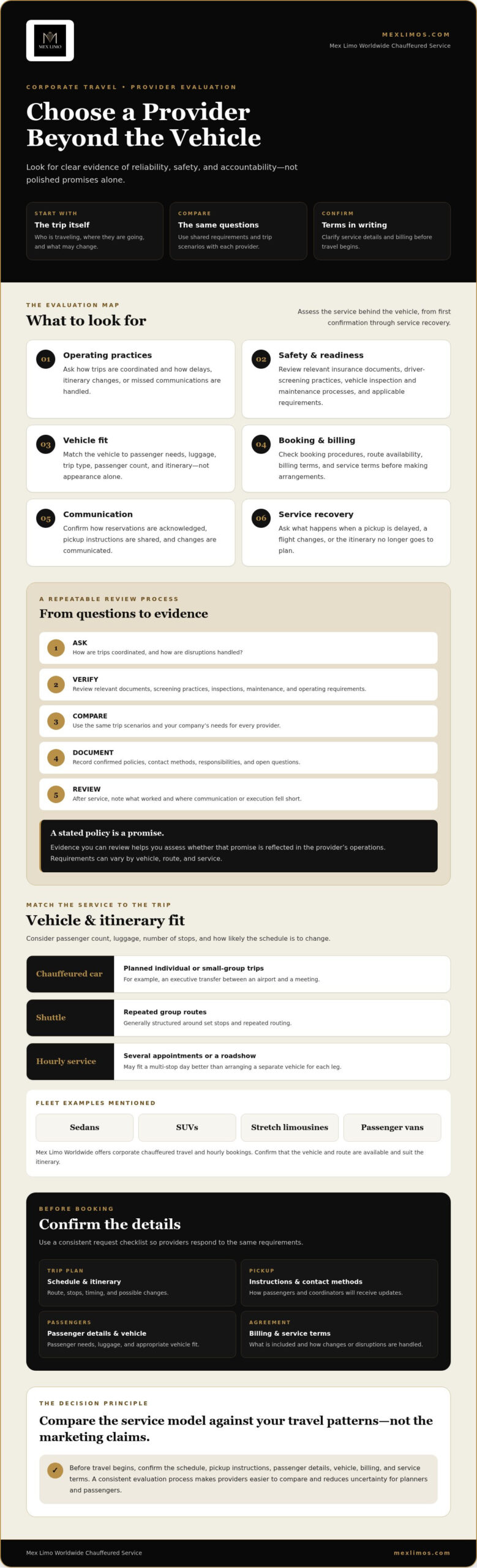
Reliability depends on operating practices, not just a promise to arrive on time. Ask for clear explanations and check whether the provider can support them with documentation and consistent communication. Use a repeatable evaluation process:
- Ask how trips are coordinated and how delays, itinerary changes, or missed communications are handled.
- Verify relevant insurance documents, driver-screening practices, vehicle inspection and maintenance processes, and applicable operating requirements.
- Compare each provider’s procedures against the same trip scenarios and your company’s needs.
- Document confirmed policies, contact methods, responsibilities, and unresolved questions.
- Review the service afterward, noting what worked and where communication or execution fell short.
A stated policy is a promise. Evidence you can review helps you assess whether that promise is reflected in the provider’s operations. Requirements can vary by vehicle, route, and service, so ask which rules apply to your booking and how the provider demonstrates compliance. Broad claims about safety or experience do not answer every question your company may need to resolve.
Questions that reveal whether reliability is operational
Ask how reservations are confirmed, who communicates changes before and during the trip, and what happens if the vehicle, chauffeur, or itinerary unexpectedly changes. If your company needs trip reporting or service updates, ask what the provider can share. These questions clarify who is responsible for communication and what information your travel coordinator can expect when plans shift.
How to assess safety and contingency planning
Ask for written information about driver screening, vehicle inspections, maintenance practices, insurance coverage, and applicable operating requirements. Find out how the provider escalates a concern and what backup arrangements it uses if a vehicle or chauffeur becomes unavailable. Treat these as items to verify, not procedures to assume. For airport transfers, ask whether flight updates are monitored and how changes to arrival times affect pickup coordination.
Mex Limo Worldwide states that it uses professional chauffeurs and real-time flight tracking for airport transfers. Confirm the details that apply to your route and booking, and request supporting information for any safety or insurance claims you need to assess. Reviewing corporate chauffeured travel as one option can be part of the same comparison you make with other providers.
Compare Fleet Fit, Booking Terms, and Corporate Service Options
A suitable vehicle should do more than look polished at the curb. Appearance can contribute to a professional arrival, but passenger comfort, luggage space, and itinerary determine whether a vehicle works in practice. Compare the available vehicles and service terms against the actual trip your company needs.
Match the vehicle and service model to the itinerary
Ask providers to confirm passenger capacity and luggage fit for the specific vehicle rather than relying on a general vehicle category. Sedans may suit individual executive trips. SUVs and passenger vans may better meet some group or luggage needs. Stretch limousines are another option, depending on the journey and service requirements. Confirm suitability and availability before booking.
An hourly booking may work well for a roadshow, several scheduled stops, or a meeting calendar that could shift during the day. For a straightforward point-to-point journey, another booking model may be more appropriate. Request a side-by-side comparison like this:
| Trip type | Passenger capacity and luggage | Booking model | Service details to confirm |
|---|---|---|---|
| Airport transfer | Passenger count and bags | Point-to-point or other offered option | Pickup instructions and flight-related procedures |
| Multi-stop itinerary | Group size and luggage needs | Hourly or another suitable arrangement | Stop changes and schedule flexibility |
| Group movement | Required seating and baggage space | Booking model suited to the route | Vehicle availability and trip coordination |
Use the table to identify gaps, not to assume every provider offers every booking model. Mex Limo offers sedans, SUVs, stretch limousines, passenger vans, and hourly bookings for corporate travel. Confirm that the vehicle is suitable and available for your itinerary. You can also review corporate chauffeured travel as part of your comparison.
Compare service terms before comparing quotes
A quote is useful only when you know what it includes. Ask each provider about minimum booking duration, included waiting time, additional stops, cancellation terms, and how billing changes if the itinerary is revised. Get answers in writing, especially when a term could affect your schedule or final invoice.
Then request an itemized quote for the actual itinerary. Give each provider the same route, timing, passenger count, luggage needs, stops, and requested service details. This makes it easier to compare equivalent proposals, identify exclusions, and weigh vehicle fit, booking terms, and service alongside price.
Build a Corporate Transportation Checklist Before You Book
Before requesting proposals, write down how your company travels and what you expect from the service. A shared brief gives providers the same information, makes responses easier to compare, and helps expose gaps before they affect a trip. It turns your evaluation into a practical set of requirements.
Information to gather before contacting providers
Describe your expected travel patterns rather than relying on one sample journey. Separate airport transfers, executive trips, roadshows, and recurring bookings, since each may involve different schedules, passengers, and coordination needs.
- Trip profile: Typical frequency, schedules, pickup windows, stops, and likely itinerary changes.
- Passenger requirements: Passenger counts, luggage needs, and accessibility considerations to discuss with providers.
- Booking process: Who arranges travel, who approves bookings, and which contacts should receive trip updates.
- Administration: Invoicing needs, billing contacts, and the appropriate escalation contact if a service issue arises.
Set priorities before sending the brief. Identify essential requirements, such as a suitable vehicle for a recurring group trip, and distinguish them from preferences. A consistent request helps prevent attractive but unverified claims from outweighing practical fit.
A simple scorecard for comparing proposals
Use the same itinerary assumptions for every proposal and assess each response against consistent criteria. A simple “meets,” “partly meets,” or “needs confirmation” rating can be more useful than an overall impression.
- Service fit: Does the proposed booking model suit the trip pattern?
- Operating procedures: Are relevant processes explained clearly and supported with documentation where needed?
- Fleet match: Are vehicle suitability and availability confirmed for the passenger and luggage requirements?
- Communication: Are booking contacts, trip updates, and escalation steps clear?
- Commercial clarity: Are billing, waiting time, cancellation, and other applicable terms stated in writing?
Record unanswered questions and request written clarification before selecting a provider. If your company’s needs and the provider’s terms allow, consider a small pilot or review period before relying on the service for a broader travel program. Compare the experience with your original criteria, then update the brief if needed.
Have your trip requirements ready? Discuss your corporate travel needs with Mex Limo, and confirm route availability, vehicle fit, and applicable booking terms for your itinerary.
Choose a Corporate Transportation Partner and Confirm the Details
Choose the provider whose documented operating approach fits your travel needs, not the one making the most attractive claims. Before committing, check that the proposed service suits the actual itinerary and that key arrangements are clear in writing. A final review helps establish who is traveling, where they are going, and how the booking will be handled.
What to confirm in writing before the first booking
Review the trip details with the provider and keep a written confirmation that your travel coordinator and passengers can refer to. Check that it includes:
- Itinerary and timing: Pickup location, schedule, stops, and any relevant pickup window.
- Passenger and vehicle details: Passenger count, vehicle type, and any luggage or accessibility requirements discussed.
- Contacts and instructions: Passenger pickup instructions, booking contact, and the appropriate contact for trip updates.
- Service and billing terms: The agreed booking terms, invoice process, and billing contact.
- Changes and delays: How itinerary updates, delays, and urgent communication will be handled.
If a detail changes before travel, request an updated confirmation instead of relying on an informal assumption. Clear records help prevent mismatched expectations and give your team a reference if a question arises afterward.
How Mex Limo may fit a corporate travel requirement
Mex Limo Worldwide offers corporate chauffeured travel and hourly bookings, with sedans, SUVs, stretch limousines, and passenger vans in its fleet. Hourly bookings may suit multi-stop itineraries or roadshows, while the right vehicle depends on passenger, luggage, and schedule requirements. Confirm the vehicle, service details, and availability for your requested route.
Use relevant corporate travel and chauffeured vehicle guidance alongside your written comparison criteria. No guide replaces confirming the details of the actual trip with the provider. Resolve any remaining questions about the itinerary, route availability, booking terms, and vehicle fit before confirming.
To explore whether Mex Limo’s corporate chauffeured travel or hourly bookings suit your company’s plans, discuss your itinerary and requested route with the team. A well-confirmed booking starts with precise details and clear expectations.
Make Your Next Corporate Transportation Choice With Confidence
To decide what to look for in a corporate transportation provider, prioritize documented operating fit over polished but unverified promises. Compare communication practices and service terms, confirm that the vehicle and booking model suit your itinerary, and get essential trip details in writing before the first pickup. These steps help your team make a considered choice and give passengers a clearer, more coordinated experience.
Mex Limo Worldwide offers corporate chauffeured travel and hourly bookings for multi-stop itineraries. The company lists professional chauffeurs, real-time flight tracking for airport transfers, and 24/7 availability as service attributes. Confirm the route, vehicle, booking terms, and service details for your plans. Discuss your corporate transportation requirements with Mex Limo to explore an arrangement that fits your travel program.
Frequently Asked Questions
What should I look for in a corporate transportation provider?
Look for documented operating practices, suitable vehicles, clear communication, and written booking and billing terms. Compare how each company handles your actual trip needs, including passenger count, itinerary, and possible changes. Ask about insurance, driver screening, vehicle maintenance, and applicable requirements, then request written details or evidence you can review before deciding.
How can a company verify that a transportation provider is reliable?
Ask providers how they confirm bookings, communicate updates, and respond to delays or unexpected changes. Request written procedures or examples of trip updates relevant to your program, then compare responses against the same scenarios. Record commitments and unresolved questions. After a trip, review whether the pickup, communication, and agreed arrangements matched what was confirmed. This gives your team practical evidence to consider for future bookings.
What questions should I ask before booking corporate transportation?
Ask how the booking will be confirmed, who will communicate with your team, and what happens if the itinerary or assigned vehicle changes. Clarify vehicle suitability, passenger and luggage capacity, pickup instructions, and how delays are handled. Request the applicable booking, waiting, cancellation, and billing terms in writing. Raise any requirements for invoice details or an escalation contact before confirming the trip.
How do I choose the right vehicle for a corporate trip?
Choose based on passenger count, luggage, comfort, and itinerary, not appearance alone. A sedan may suit an individual traveler, while an SUV or passenger van may better meet some group or luggage needs. Confirm actual capacity and suitability with the provider, since specifications and availability can vary. For multiple stops or a changing schedule, consider whether the booking model supports the itinerary. Discuss accessibility needs before reserving.
Is hourly chauffeured service better for a corporate roadshow?
Hourly chauffeured service can suit roadshows with several stops or a schedule that may change, because the booking reserves a vehicle and chauffeur for a period of time. It is not automatically the right choice for every itinerary. Compare it with other available booking options, and confirm any minimum duration, waiting-time rules, extra-stop terms, and how schedule changes affect the booking.
What should a corporate transportation quote include?
A useful quote should describe the itinerary, schedule, passenger count, vehicle type, and service model, along with applicable booking and billing terms. Ask for an itemized quote that identifies included services and possible additional charges, such as waiting time or itinerary changes. Give each provider the same trip details to make proposals easier to compare. Confirm final terms in writing rather than relying on assumptions.
How can a transportation provider handle flight delays or itinerary changes?
Ask what the provider monitors, how updates reach the chauffeur or dispatch, and whom travelers should contact if plans change. Clarify how revised pickup timing, waiting, and any resulting billing are handled. Mex Limo states that it uses real-time flight tracking for airport transfers. Confirm how that process applies to your booking, along with route availability and the communication steps for delays or itinerary changes.