
Verifying a transportation company’s credentials starts with identifying the service you’re booking. Requirements can differ between passenger transportation and freight, so the most official-looking credential may not answer the right question for your trip. A company website can explain its services, while official records can help you check applicable details.
Before trusting a company with your time and comfort, it’s reasonable to look for clear evidence of legitimacy. This practical checklist explains which records may apply, how to consult official sources such as the FMCSA SAFER database when relevant, and why a USDOT lookup isn’t a universal test for every chauffeured service.
There’s more to review than paperwork. Check that company and booking details are clear, and consider service practices such as pickup coordination, vehicle preparation, and chauffeur assistance. Mex Limo Worldwide Chauffeured Service provides transportation and customer support 24/7. For airport transfers, vehicles arrive early, clean, and sanitized. These details can help you make a more informed booking decision for business travel, an airport transfer, or a special occasion.
Key Takeaways
- Start by identifying the transportation service and jurisdiction so you can focus on records that apply to the journey.
- When verifying a transportation company’s credentials, match official records to the exact legal or trading name in the booking documents.
- Use official databases relevant to the operator and service, and treat each record as one part of a broader review.
- Assess service-quality signals alongside paperwork, including clear booking details, vehicle preparation, pickup arrangements, and chauffeur professionalism.
- Mex Limos has operated since 2009, with transportation and customer support available 24/7. These are service details to consider, not certifications.
Why verifying a transportation company’s credentials starts with the service type
A credential is a record or other evidence that helps establish something specific about a transportation company, its service, or its authority to operate in a particular jurisdiction. The right evidence depends on what you’re booking. A freight carrier moving cargo and a chauffeured service carrying passengers don’t necessarily have the same verification needs. A search designed around freight may not answer a passenger’s questions.
Start by defining the journey: passenger or cargo, local or interstate, and the kind of service involved. Transportation in the United States includes distinct passenger and freight activities, with different operational contexts and oversight. The Transportation in the United States overview provides background on that broader system. The practical point is simple: don’t assume a record applies to every service just because it appears in a transportation database.
What counts as a transportation company credential?
Official records may show registration, operating authority, insurance, or safety information, depending on the operator and the rules that apply. Company statements, testimonials, and booking details can also help you assess a service, but they’re different kinds of evidence. A polished website isn’t an official record, and a positive review doesn’t establish regulatory status.
There isn’t one licensing system that applies identically to every passenger operator. Relevant documents and databases can vary with the service and jurisdiction. Match the evidence to the question you’re trying to answer: Is this the correct company? Does a particular operating record cover the activity? Do the service details support the journey you intend to book?
Why freight-carrier searches may not answer passenger questions
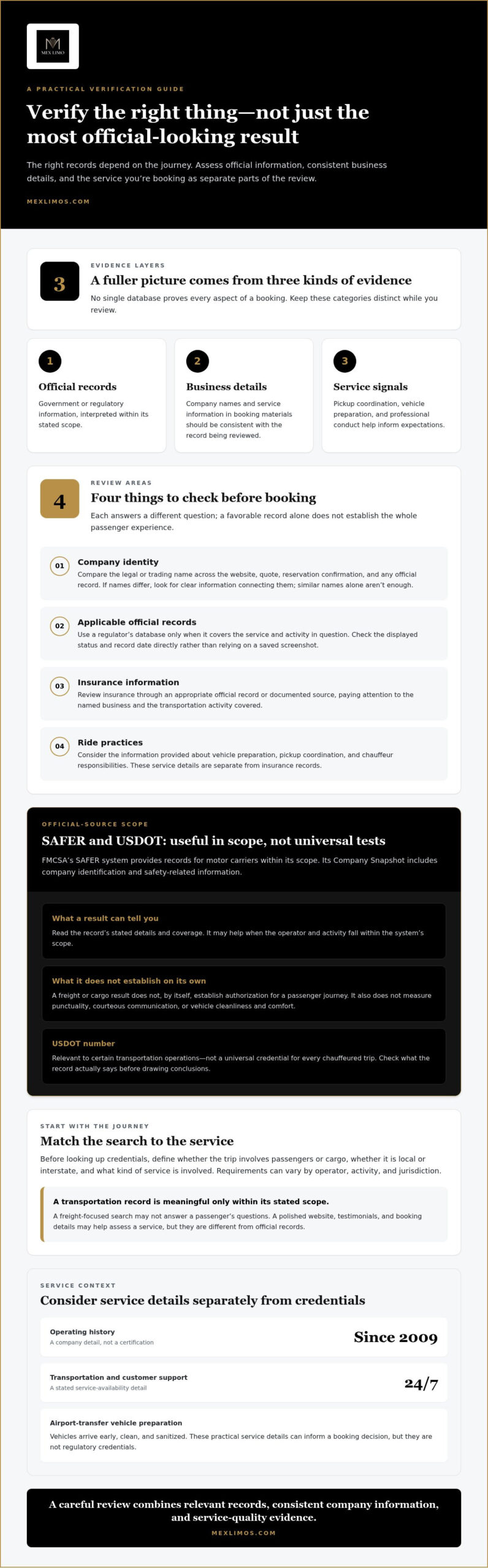
The FMCSA’s SAFER system provides records for motor carriers within its scope, including a Company Snapshot with company identification and safety-related information. It can be a useful official source when the operator and activity fall within that scope. Read the details stated in the record rather than treating every result as a universal passenger-service credential.
A result that describes freight or cargo activity doesn’t, by itself, establish that a company is authorized for a passenger journey. It also doesn’t tell you whether a chauffeur will arrive punctually, communicate courteously, or provide a clean, comfortable vehicle. Those are separate questions. A record can inform your review without measuring the full passenger experience.
Keep three categories distinct as you begin verifying a transportation company’s credentials:
- Official records: Evidence from a government or regulatory source, interpreted within its stated scope.
- Business details: Names and service information shown in booking materials, which should be consistent with the record you’re reviewing.
- Service-quality signals: Practical indications such as pickup coordination, vehicle preparation, and professional conduct.
No single database proves every aspect of a booking. A careful review combines relevant official records with consistent company information and service-quality evidence. The checklist that follows helps you identify which details matter, consult relevant sources, and avoid treating freight-specific checks as a complete test of chauffeured passenger service.
Which records and service details should you verify before booking?
A useful review brings together four kinds of information: company identity, applicable official records, insurance documentation, and the practices that shape the ride. Each answers a different question. A registration record may identify an operator, while booking details clarify who is providing your trip and a service description explains what to expect. No favorable database result, on its own, proves punctuality or attentive customer care.
Company identity and applicable registration records
Compare the legal or trading name across the company website, quote, and reservation confirmation. If a record uses a different name, look for information that clearly connects it to the business named in your booking. Similar names alone aren’t enough. Search an official regulator’s database only when it covers the service and activity in question, then review the displayed status and record date directly rather than relying on a saved screenshot.
A USDOT number is relevant to certain transportation operations, not a universal credential for every chauffeured trip. The USDOT Number Requirements from FMCSA explains when the federal identifier applies. Interpret any result according to its stated coverage, and don’t infer passenger-service authorization from an identifier without checking what the record actually says.
Insurance, vehicle readiness, and chauffeur service
Review insurance information through an appropriate official record or documented source, paying attention to the named business and the transportation activity it covers. Assess service evidence separately. Descriptions of vehicle preparation, pickup coordination, and chauffeur responsibilities can help set expectations, but they aren’t substitutes for insurance records. General statements about experience also don’t independently establish a licence, screening process, or certification.
- Identity: Compare the company name and contact details on the website, quote, and reservation confirmation.
- Official records: Check the regulator’s own database for information relevant to that operator and service, including status and record date.
- Insurance: Confirm that documented coverage names the appropriate business and relates to the booked transportation activity.
- Service practices: Look for clear descriptions of vehicle preparation, pickup arrangements, and chauffeur assistance, without treating marketing language as official proof.
For an airport transfer, for example, a record can provide information about an operator, while details about vehicle cleanliness, early arrival, and luggage assistance speak to the passenger experience. Mex Limos has operated since 2009, and transportation and customer support are available 24/7. These are practical service details, not certifications or substitutes for relevant records.
Apply the same careful approach to business travel, where coordinated pickups and a polished passenger experience matter alongside paperwork. If you’re arranging a chauffeured journey, explore Mex Limos transportation services and review the booking details alongside the service practices described.
How to verify a transportation company using official sources
A reliable lookup is a sequence, not a single search result. Begin with the service you’re booking and the exact company name on your quote or reservation, then choose a source that covers that operator and activity. This keeps verifying a transportation company’s credentials focused on records that can answer your question.
- Define the service. Note whether the trip involves passenger or freight transportation and whether it crosses jurisdictional boundaries. This gives you a basis for deciding which regulator’s records may be relevant.
- Write down the exact company name. Use the legal or trading name shown in the booking documents. If the company provides an identifier, such as a USDOT number, record it too. Don’t assume every passenger service is covered by the same federal lookup.
- Choose an official database within scope. For a motor carrier covered by the federal system, use the FMCSA SAFER System for Carrier Verification. Its Company Snapshot search options include a USDOT Number, MC/MX Number, or Company Name. Select the identifier that best matches the information you have.
- Compare the result with your documents. Check that the returned company identity and any relevant identifiers align with the business named on your quote or confirmation. If a search returns several similar names, don’t assume the first result is the right operating entity.
- Save the context. Note the database used, the lookup date, the search term, and the details you reviewed. Read each field according to its description and scope, and resolve material inconsistencies before relying on the result.
Using FMCSA SAFER without overreading the result
SAFER’s Company Snapshot is a federal carrier record, not a complete assessment of every chauffeured service. A search by company name can help locate a possible match, while an identifier may narrow the search. Either way, compare the record’s identity information with your booking details, and interpret it only for an operator and activity within SAFER’s coverage.
Don’t treat one field, or the presence of a record, as universal proof that a passenger service is legitimate, suitable, or dependable. The result can inform your review, but it doesn’t establish service quality such as punctuality, vehicle condition, or chauffeur conduct. Read what the record actually states.
Cross-checking company details and documented information
Compare the returned business name and identifiers with the company name on your quote and reservation confirmation. Contact details can provide another point of comparison, but a small formatting difference isn’t automatically evidence of a problem. Focus on whether the documents and official record appear to describe the same operating entity.
If names or identifiers materially conflict, pause before relying on the search. Recheck the spelling and identifier entered, then seek an explanation through a documented company channel. Keep the source and lookup date with your notes so you can distinguish a current official result from an old screenshot or an unrelated record.
Passenger Transport Checklist: Signals and Assumptions
A passenger booking deserves a broader review than a database search alone. Keep three evidence categories distinct: official records, consistent business and booking details, and signs of service quality. An active record may show information about an operator within a database’s scope, but it can’t promise a punctual pickup, establish that a particular vehicle suits your journey, or describe how a chauffeur will treat passengers.
Useful signals versus proof a database cannot provide
Use a government record to assess only the details it explicitly displays, such as operator identity or status covered by that source. Separately, review the company’s service description and customer feedback for clues about communication, vehicle preparation, and passenger care. Testimonials and polished branding can add context, but neither replaces an applicable official record or proves that every trip will be identical.
Keep this distinction in view as you review the evidence:
| What a record or signal can show | What it cannot establish | Next check |
|---|---|---|
| An official database entry may display an operator’s identity and stated record details. | It doesn’t automatically confirm that the record covers your passenger service or journey. | Review the source’s scope and compare the operator name with your booking documents. |
| Consistent names and identifiers can help connect a booking to a business record. | A name match alone doesn’t demonstrate suitable service or attentive care. | Compare the quote, reservation confirmation, and relevant official record. |
| Detailed service information and customer feedback can indicate what passengers have experienced. | Reviews aren’t official proof, and they can’t guarantee your trip’s punctuality or comfort. | Look for specific, relevant descriptions of the service rather than relying on praise alone. |
When records and booking details do not match
A discrepancy deserves attention, not an immediate accusation. Recheck spelling, punctuation, trading names, and any identifier you entered. Then confirm that the record covers the operator and activity you intended to look up. A difference may reflect a search error or a business-name variation, but don’t dismiss a material mismatch without an explanation.
If the inconsistency remains, pause before completing the booking and use a documented company contact channel to resolve it. Compare the response with the names and details in the reservation documents; avoid relying on an informal assurance that leaves the operating entity unclear. For corporate journeys, coordination and passenger experience are part of the planning, so the corporate chauffeured travel guide offers further context. For a chauffeured booking, review Mex Limos’ transportation services as you consider the details that matter to your trip.
Use the checklist as a balanced assessment, not a pass-or-fail shortcut. Verifying a transportation company’s credentials means matching relevant records to the actual passenger service, then weighing those records alongside clear booking information and practical service signals. This helps you make a more informed decision without mistaking a database entry, a testimonial, or a polished presentation for the whole story.
How Mex Limos builds confidence in a chauffeured transportation booking
Official records help answer specific questions about an operator, while a booking also calls for a practical view of the service itself. Mex Limos has operated since 2009, with transportation and customer support available 24/7. These are service facts to consider alongside applicable records, not certifications or a promise that every journey will unfold the same way.
What passengers can expect from Mex Limos
Mex Limos describes its chauffeurs as professional and experienced and its luxury fleet as modern, clean, and well-maintained. For airport transfers, vehicles arrive early, clean, and sanitized. Chauffeurs assist with luggage and escort passengers to the vehicle, providing clear personal assistance during the arrival process.
Hourly service provides a private chauffeur and limousine for the duration requested, which can suit an itinerary that needs flexibility rather than a single drop-off. Point-to-point service can follow a direct route or include multiple stops, helping passengers plan connected appointments or a sequence of destinations. Consider how each service format aligns with your schedule rather than assuming one booking style fits every trip.
These details are useful service-quality signals when verifying a transportation company’s credentials, but they serve a different purpose from official records. Records address information shown by the relevant authority; the company’s stated practices help you understand the passenger experience it describes. Keep those categories distinct as you consider comfort, coordination, and professional service.
Choose the booking format that fits the journey
Start with the occasion and itinerary. Airport transfers are for airport journeys; corporate chauffeured travel supports business transportation; leisure travel and special-event service suit personal outings and celebrations. For an itinerary with several stops or a schedule that benefits from a private vehicle over a requested period, point-to-point or hourly service may be a better fit. Matching the format to the journey makes the booking details more useful.
Before reserving, review the trip information you’ll provide, including pickup and destination details, timing, and any planned stops. Clear details help align the reservation with the journey you have in mind. Mex Limos accepts bookings through its online reservation system or by phone, and pricing is available through Quick Quote or online reservations.
For a closer look at chauffeured luxury vehicle options, consider which vehicle category and service format suit your plans. When you’re ready to see pricing for your itinerary, request a Quick Quote.
Make your next journey a considered choice
Once you’ve assessed the records and service details relevant to your trip, consider what will make the journey feel composed from pickup to arrival: clear reservation information, a service format suited to your plans, and the level of comfort you expect. Verifying a transportation company’s credentials is one part of booking with confidence; choosing thoughtfully helps carry that confidence into the experience.
Mex Limos brings a considered approach to chauffeured travel, with attention to passenger comfort and practical details that support a polished journey. Transportation and customer support are available 24/7. Whether you’re arranging a business trip or a personal occasion, you can take the next step at your own pace.
Request a Quick Quote or make an online reservation to begin planning your chauffeured ride. A little care before booking can set the tone for a more comfortable, confident journey.
Frequently Asked Questions
How can I verify a transportation company’s credentials?
Start with the journey and the company’s exact name, then use official records that cover the service and operator. Compare the result with your reservation information and review any documented insurance or service details separately. For example, an airport transfer and a freight shipment may call for different checks. Verifying a transportation company’s credentials is a records review, not a prediction of how a particular ride will go.
Is FMCSA SAFER useful for checking every transportation company?
No. FMCSA SAFER provides Company Snapshot information for carriers and operations within its scope, so it isn’t a universal directory or passenger-service rating. Search using an appropriate company identifier, then read the fields shown and what they cover. If you’re considering a chauffeured ride, use any relevant SAFER result as one reference point alongside matching business details and clear information about the service you’re reserving.
What is the difference between a transportation company’s credentials and a driver background check?
Company credentials relate to the business or operation; a background check concerns an individual driver and may be part of an employer’s screening process. These are separate questions. A website describing screening services doesn’t establish that a specific employer conducted a particular check on a particular driver. If you’re reviewing documentation, identify who or what it covers, who issued it, and whether it applies to the company or the individual.
Can I verify a transportation company by its name alone?
A company-name search can help you find a possible record, but it may not uniquely identify the operator. Compare the result with the legal or trading name on your booking documents, and use an identification number if the official database accepts one and you have it. A similar business name isn’t enough to confirm a match. Check that the record refers to the same operating entity and relevant activity.
What should I do if a company’s records do not match its booking details?
First, check for a misspelling, a trading name, an outdated document, or an incorrectly entered identifier. Then compare the booking information with the official record again. If the difference affects the identity of the operator or remains unclear, pause before proceeding and use a documented company contact channel to resolve it. A mismatch merits attention, but it doesn’t by itself prove fraud. Keep a note of the explanation and documents reviewed.
Do online reviews prove that a transportation company is properly credentialed?
No. Reviews describe reported customer experiences, not regulatory standing, insurance, or other official records. They may still help you assess what passengers say about details such as communication or vehicle cleanliness. Read comments for specific experiences and context rather than treating a high rating or a single testimonial as proof. Then compare those experience signals with applicable official information and the service details in your reservation.
How can I assess a chauffeured company’s reliability beyond official records?
Look for concrete service practices that affect your itinerary, such as how airport pickups are handled, what passenger assistance is described, and whether booking details are clear. Mex Limos provides transportation and customer support 24/7. For airport transfers, vehicles arrive early, clean, and sanitized, and chauffeurs assist with luggage. Consider these service signals, not certifications or guarantees about an individual trip.