
What makes a private-jet pickup run smoothly is often not the car’s scheduled arrival, but a well-planned handoff. Coordinating with a private jet arrival can feel uncertain when landing times shift, the pickup location isn’t clear, or the traveler, flight contact, and chauffeur have different details. A fixed pickup time alone may not account for the steps between touchdown and meeting the vehicle.
Share the flight details, passenger count, luggage needs, and intended meeting point in advance so the ground transfer can be planned around the itinerary. Real-time flight tracking gives the chauffeur useful context when timing changes, while a meet-and-greet option can help make the transition more straightforward. This guide explains what to communicate before travel, how tracking supports pickup coordination, and how to choose a suitable vehicle for the onward journey. With professional chauffeurs and a choice of sedans, SUVs, stretch limousines, and passenger vans, an airport transfer can complement a private flight with a composed, well-organized arrival.
Key Takeaways
- Align the pickup plan with the aircraft’s arrival process, not just its estimated landing time.
- For coordinating with a private jet arrival, share the flight identifier, pickup location, passenger count, and a reachable day-of contact.
- Use flight tracking to inform timing, while keeping communication open for delays after landing.
- Agree on clear meeting instructions and reconnect after touchdown so passengers and chauffeur can find one another.
- Match the vehicle to the group, luggage, and onward plans for a more comfortable transfer.
Coordinating with a Private Jet Arrival Starts with the Ground-Travel Handoff
A private aircraft arrival doesn’t follow the same pickup pattern as a scheduled airline flight. Passengers may leave the aircraft through a Fixed-Base Operator (FBO) rather than a public terminal, and the handoff depends on the airport and operator. Coordinate vehicle readiness around where passengers will meet the chauffeur and when they’re cleared to leave, not simply the aircraft’s estimated landing time.
A coordinated private-jet transfer aligns flight updates, passenger communication, pickup instructions, and vehicle readiness so the onward journey can proceed smoothly once passengers are ready. It gives everyone a shared plan without assuming touchdown and departure from the airport happen at the same moment.
How a private-aircraft arrival differs from an airline pickup
With an airline arrival, travelers generally follow signs to a public baggage claim or designated curb. A private-flight passenger may instead be directed to an FBO or another location specified by the airport or operator. The chauffeur needs that precise meeting instruction. “At the airport” doesn’t establish where the handoff will take place.
There can also be a gap between landing and passengers being ready to leave. They may need to complete the airport or operator’s arrival process and gather their belongings. For coordinating with a private jet arrival, treat the landing estimate as useful context, not a promise that passengers will immediately be at the vehicle.
Who needs to be aligned before the flight lands?
The traveler or assistant, flight contact, chauffeur, and pickup-location contact each hold part of the plan. One designated person, often the assistant or trip organizer, should relay itinerary changes to the transportation provider. A single communication lead reduces the risk of conflicting updates and lets the traveler focus on the arrival.
Keep messages concise and discreet. Share essential updates, such as a revised arrival estimate or meeting-point change, with the people responsible for the transfer. Confirm how the chauffeur and traveler or representative will reconnect once passengers are ready. This gives everyone a clear next step without circulating unnecessary personal or itinerary details.
Before departure, establish the planned pickup location, who will communicate changes, and how the parties will reconnect after landing. If the airport or operator adjusts the passenger handoff, the designated contact can pass along the new instruction. The chauffeur can then work from the latest shared information, while the traveler has a defined route from aircraft to ground transportation.
What Arrival Details Should You Share Before the Private Jet Departs?
A clear transfer brief gives the chauffeur and transportation provider the information needed to plan the pickup while leaving room for itinerary changes. Share the expected arrival details before departure, then send updates through one agreed communication channel if the flight plan or passenger arrangements change. The NBAA flight planning best practices resource includes ground transportation among the considerations involved in planning a flight, underscoring the value of treating the onward journey as part of the itinerary.
Flight and pickup information to prepare
Distinguish the aircraft’s flight identifier from the ground contact’s name and phone number. The identifier connects the transfer to the flight; the day-of contact gives the chauffeur or coordinator someone to reach if pickup details shift. Provide the scheduled arrival estimate, intended airport, planned pickup location, and any instructions supplied by the flight operator or airport.
Access and meeting procedures can differ by airport and FBO, so use instructions for that specific arrival rather than assuming a universal curbside or terminal pickup. Send the initial plan in advance, then promptly relay changes, such as a revised arrival estimate or pickup point, through the agreed channel.
Passenger, luggage, and onward-trip details
Vehicle selection depends on more than passenger count. Include the number of travelers, the amount and type of luggage, the destination, and any planned stops so the transfer suits the full itinerary. A sedan may suit a smaller party with limited luggage, while an SUV or passenger van may better accommodate a larger group or more bags. Share child-seat or accessibility needs when they apply.
Before the flight departs, organize the information into a concise brief:
- Flight: Identifier, operating contact, and scheduled arrival estimate.
- Pickup: Airport, intended meeting location, and operator-provided instructions.
- Passengers: Traveler count, luggage needs, and any relevant accessibility or child-seat requirements.
- Journey: Destination, planned stops, and a reachable day-of contact.
Keep stable details, such as the destination and passenger count, in the original brief, and update anything that changes. This makes coordinating with a private jet arrival clearer for everyone involved. For a planned onward journey, chauffeured airport transfers can bring the flight itinerary and ground transportation plan together.
Flight Tracking or a Fixed Pickup Time: Which Plan Handles Arrival Changes Better?
A fixed pickup time gives everyone a clear appointment, but it can become out of step with a changing arrival estimate. Flight-aware coordination adds aircraft-status context, helping the traveler, transportation provider, and chauffeur adjust their communication as the trip develops. Neither approach removes the need to account for what happens after touchdown.
Flight tracking can show the ground-transport team how the aircraft’s estimated arrival is changing, but it can’t confirm when passengers will be ready at the pickup point. Landing, taxiing, completing airport or FBO procedures, and reaching the agreed meeting location are separate milestones. The plan should allow for those steps and for passenger-side delays.
| Pickup approach | What it offers | What still needs coordination |
|---|---|---|
| Fixed pickup time | A straightforward appointment when the itinerary is stable. | A changed arrival estimate may make the original time less useful; the day-of contact should share updates. |
| Flight-aware coordination | Aircraft-status context that can inform pickup timing and communication. | Passenger readiness, FBO procedures, and access instructions still need to be communicated separately. |
What real-time flight tracking can contribute
Real-time flight tracking gives a chauffeur or transportation coordinator useful context when an aircraft’s estimated arrival changes. That information can help the team communicate with the traveler or designated contact and plan around the revised estimate. It supports a more responsive airport transfer than relying only on an unchanged appointment time.
Tracking isn’t a passenger-readiness signal. It can’t establish when passengers have completed arrival procedures, gathered their belongings, or reached the agreed meeting point.
When a fixed pickup time still needs a communication plan
A fixed appointment can work well when the itinerary is steady and the pickup location is clear. Pair it with a designated day-of contact and an agreed channel for sharing revised flight estimates. That way, a change in flight timing reaches the transportation team promptly instead of leaving the chauffeur to rely on an outdated schedule.
Keep timing changes distinct from access or release instructions. A later arrival estimate doesn’t automatically change where a vehicle may meet passengers or when they can leave the aircraft area. Those details depend on the airport or FBO process and should be relayed separately. For coordinating with a private jet arrival, flight tracking is one useful input in a flexible plan, not a substitute for clear passenger communication.
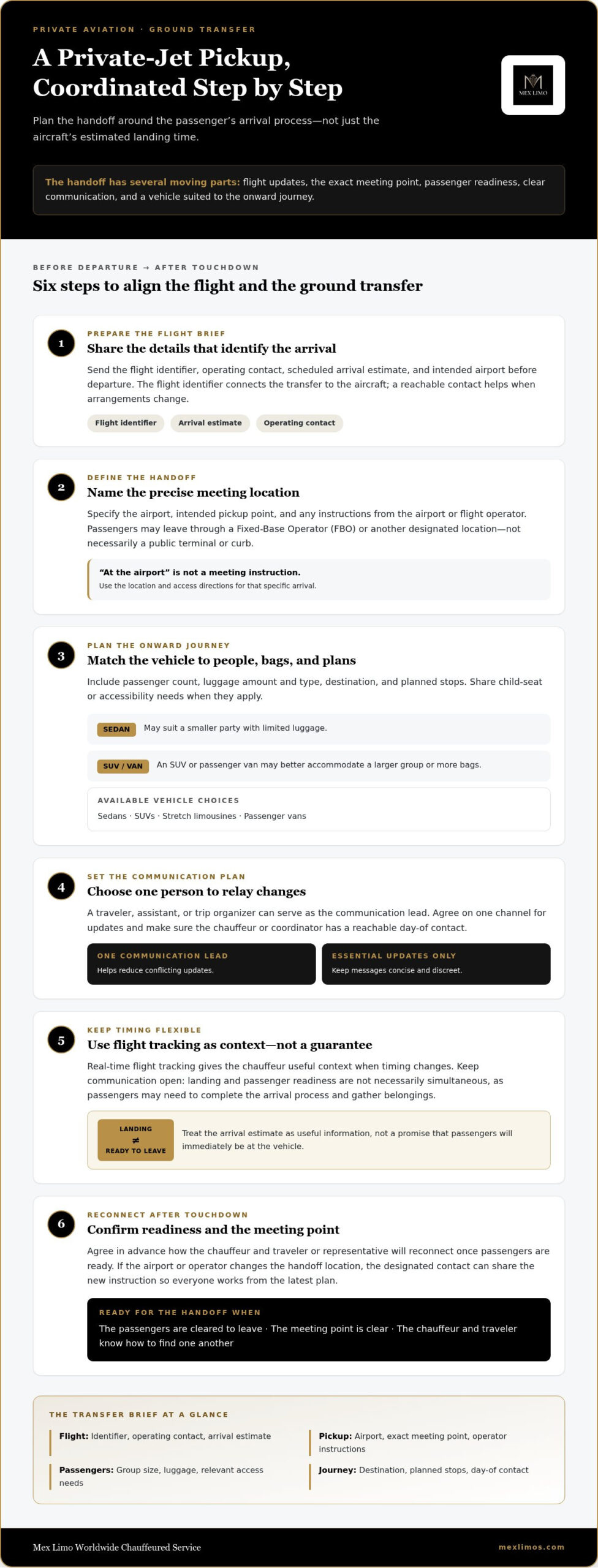
How to Coordinate a Private-Jet Pickup: A Step-by-Step Checklist
A short, shared plan helps the traveler, trip organizer, and chauffeur work from the same details. Use this sequence to arrange the vehicle, communicate changes, and clarify the passenger handoff without treating the aircraft’s estimated landing time as the pickup time.
Before departure: arrange the vehicle and share the itinerary
Build the ground-transfer plan around the flight, passenger needs, and onward journey. For an executive itinerary, corporate chauffeured travel can complement a carefully coordinated schedule.
- Arrange the transfer. Provide the expected arrival details, passenger count, luggage needs, and destination so the vehicle can be matched to the party and journey.
- Share the itinerary. Send the flight identifier, scheduled arrival estimate, airport, planned pickup location, and a reachable day-of contact. Identify one person, such as the traveler’s assistant, to relay changes to the transportation provider.
- Confirm pickup instructions. Record the airport or FBO’s meeting and access directions, then share them with the traveler and chauffeur. Don’t assume the vehicle can meet passengers at a public curb; follow the process for that specific arrival.
On arrival day: confirm updates and the passenger handoff
Use flight-status information as context for timing, then keep the agreed contact channel open. A revised estimate can inform the pickup plan, but it doesn’t confirm when passengers will be ready or whether the handoff instructions have changed.
- Monitor and relay meaningful updates. The designated contact should promptly pass along changes to the arrival estimate or pickup instructions. Mex Limo Worldwide Chauffeured Service’s airport transfers include real-time flight tracking, which can inform coordination without predicting every passenger-side delay.
- Reconnect after landing. Follow the airport or FBO’s pickup process. The traveler or representative should let the chauffeur know when passengers are ready and confirm where to meet, using the agreed communication method.
Before arranging the vehicle, and again if party details change, check passenger count, luggage, destination, and day-of contact method. These details help keep the vehicle and onward plan aligned as the itinerary unfolds. For a planned chauffeured airport transfer, plan a coordinated airport transfer.
A Chauffeured Transfer Makes the Private-Jet Arrival Easier to Manage
A prearranged chauffeured transfer gives the arrival a defined next step: a designated vehicle, a professional chauffeur, and an onward journey planned around the traveler’s itinerary. Instead of deciding on ground transportation after landing, the traveler or trip organizer can share essential details in advance and establish how the chauffeur and passenger will reconnect. This helps make the transition more orderly while allowing for changes in flight timing and airport procedures.
Vehicle choice is part of that planning. Consider the group, luggage, privacy preferences, and destination together, rather than selecting a vehicle by passenger count alone. For a broader overview of options, explore chauffeured luxury vehicles.
Match the chauffeured vehicle to the arrival party
A sedan may suit a smaller party with a modest amount of luggage and a direct onward itinerary. An SUV can be suitable when travelers need a different balance of space and privacy. For larger groups or distinct travel requirements, consider a stretch limousine or passenger van. Share the passenger count, luggage needs, and destination when arranging the transfer so the vehicle choice reflects the whole journey.
Privacy and the next appointment matter, too. A traveler heading directly to a business meeting may value a quiet, direct ride, while a group continuing to a private destination may prioritize room for passengers and bags. These preferences help shape a practical selection without relying on assumptions about what a particular vehicle can accommodate.
What to expect from a well-coordinated transfer
A professional chauffeur provides a dedicated point of contact for the ground journey, while real-time flight tracking offers useful context for pickup coordination. Meet-and-greet options can support a clear passenger handoff based on the agreed meeting instructions. These features help bring the flight and vehicle plans together, but tracking cannot determine when passengers are released or override airport and FBO procedures.
For coordinating with a private jet arrival, treat the chauffeur, vehicle, flight updates, and passenger communication as connected parts of the onward plan. Keep the designated day-of contact reachable and share meaningful changes through the agreed channel. The handoff is easier to manage when the traveler knows the meeting instructions and the ground team has current information.
When arranging an airport transfer, share your arrival details, passenger count, luggage needs, and destination so the onward journey can be planned with care. Arrange a chauffeured airport transfer for a composed transition from aircraft to ground travel.
Make the Ground-Travel Handoff Part of the Plan
A composed private-jet arrival begins with clear details: the flight identifier, intended pickup point, passenger and luggage needs, destination, and a reachable day-of contact. Flight tracking can inform pickup coordination as arrival estimates shift, but it can’t tell the chauffeur when passengers are ready or replace airport and FBO instructions. A shared communication plan helps bridge that final step.
For coordinating with a private jet arrival, prearranged chauffeured transportation brings the aircraft itinerary and onward journey together. Mex Limo airport transfers include professional chauffeurs and real-time flight tracking, with meet-and-greet options and a fleet of sedans, SUVs, stretch limousines, and passenger vans to suit different travel plans.
Share your arrival details and arrange a ground transfer designed around your itinerary. Arrange a chauffeured airport transfer for a considered transition from aircraft to destination.
Frequently Asked Questions
How do you coordinate a car pickup with a private jet arrival?
Arrange the ground transfer in advance and share the flight identifier, estimated arrival, airport, planned pickup location, passenger count, luggage needs, destination, and day-of contact. Designate one person to relay changes to the transportation provider, and agree how the traveler and chauffeur will reconnect. Flight updates can inform timing, but the handoff also depends on passenger readiness and the airport or FBO’s procedures.
Does flight tracking work for private jet arrivals?
Yes, real-time flight tracking provides useful aircraft-status context for coordinating an airport transfer. It can help the transportation team follow an updated arrival estimate and communicate timing changes. Mex Limo airport transfers include real-time flight tracking, but tracking doesn’t show when passengers are ready to leave the aircraft area or guarantee a precise pickup time. Keep the day-of contact available for updates beyond the flight’s status.
Where does a chauffeur meet passengers arriving by private jet?
The meeting point depends on the airport and operator’s procedures. Passengers may exit through a fixed-base operator (FBO) rather than a public airline terminal, and access or pickup instructions can vary. Share the specific location and any operator-provided directions with the chauffeur and traveler before arrival. Don’t assume that a private-flight pickup uses the same curb or passenger exit as a commercial airline arrival.
What information should I give a car service for a private flight?
Provide the flight identifier, operating contact, scheduled arrival estimate, airport, and planned pickup location, along with passenger count, luggage needs, destination, and a reachable day-of contact. Include planned stops and any applicable child-seat or accessibility needs. Keep the aircraft identifier distinct from the traveler’s ground-contact details. If the flight estimate or meeting instructions change, relay the update through the agreed communication channel.
Should I schedule a private-jet pickup for the landing time?
Use the estimated landing time as a planning reference, not necessarily as the exact passenger pickup time. After landing, the aircraft may still need to taxi, and passengers may need to complete arrival procedures before reaching the agreed meeting point. A scheduled pickup time can provide a useful starting point, while flight tracking and communication with the day-of contact help the team respond to changes.
What type of car is best for a private-jet airport transfer?
The best choice depends on passenger count, luggage, privacy preferences, and the onward itinerary. A sedan may suit a smaller party with lighter luggage; an SUV or passenger van may better fit different group and baggage needs. A stretch limousine is another option for travelers who prefer that style of transfer. Share party and luggage details in advance so the vehicle can be matched to the journey.
Can a chauffeur meet passengers inside a private aviation terminal?
A chauffeur may be able to meet passengers inside an FBO or private aviation terminal when the airport or operator’s procedures allow it and the meeting arrangement is set in advance. Access rules and passenger handoff locations aren’t universal, so use the instructions for the specific arrival. Meet-and-greet options can support a clear handoff, but they don’t override airport procedures or determine when passengers are released.