
A discount can make a corporate car service account look attractive, yet it may do little to improve a journey that’s difficult to coordinate or an expense that’s hard to review. The most valuable corporate car service account benefits are often control, continuity, and trip clarity, from dependable pickups to a clearer view of business travel.
Travel coordinators need transportation that can adapt when employee, executive, or guest schedules change. Cost matters, but a lower rate alone doesn’t show whether a service can meet the punctuality, professional hospitality, and flexibility a business itinerary demands.
This 2026 buying guide explains how to compare account benefits across service quality, administration, and trip economics. You’ll learn what to look for in billing visibility and booking coordination, how to weigh the full value of a trip rather than a discount alone, and which arrangements suit airport transfers, meetings, and multi-stop itineraries. Professional chauffeurs, real-time flight tracking, and hourly bookings for roadshows and changing schedules can make business journeys more predictable for travelers and coordinators alike.
Key Takeaways
- Assess corporate car service account benefits beyond discounts by weighing trip clarity, service consistency, and coordination needs.
- Capture passenger, pickup, timing, and itinerary details consistently to make business journeys easier to organize and review.
- Compare recurring arrangements with individual bookings against your travel frequency, itinerary complexity, and administrative requirements.
- Use a practical evaluation checklist to compare complete trip requirements rather than relying on headline discount language.
- Consider how airport transfers, hourly bookings, professional chauffeurs, and real-time flight tracking can support different corporate travel plans.
What corporate car service account benefits matter beyond a discount?
A corporate car service account is an organized arrangement for booking recurring business journeys, such as airport transfers, executive meetings, and multi-stop itineraries. It gives a company a consistent way to plan ground transportation, even when different people arrange trips or travel as passengers. Travel coordinators and executive assistants may handle bookings, while employees, executives, and business guests rely on a clear, professionally managed journey.
That structure is one part of wider corporate travel management, where travel planning considers cost control and the experience of the people traveling. A discount can be useful, but it’s only one measure. Buyers should also consider how clearly trip requirements can be communicated, whether the service suits the itinerary, and how consistently passengers are treated.
A corporate car service account creates value when it brings cost clarity, booking convenience, and consistent service together across business journeys.
Which benefits can improve everyday business travel?
For frequent journeys, a planned booking approach can reduce the need to reconstruct the same basic details each time. Keep passenger names, pickup points, schedules, and itinerary needs organized, then use that information to plan future trips. A repeatable process helps limit avoidable back-and-forth and gives coordinators a practical way to catch missing details before a journey begins.
Professional chauffeurs and punctual pickups matter when a late arrival could disrupt a meeting, flight connection, or tightly scheduled day. A guest arriving for a business visit may need clear pickup instructions and a polished welcome. Include those details in the trip plan so the traveler knows where to go and the coordinator can communicate the arrangement clearly.
Is a corporate discount the same as lower total cost?
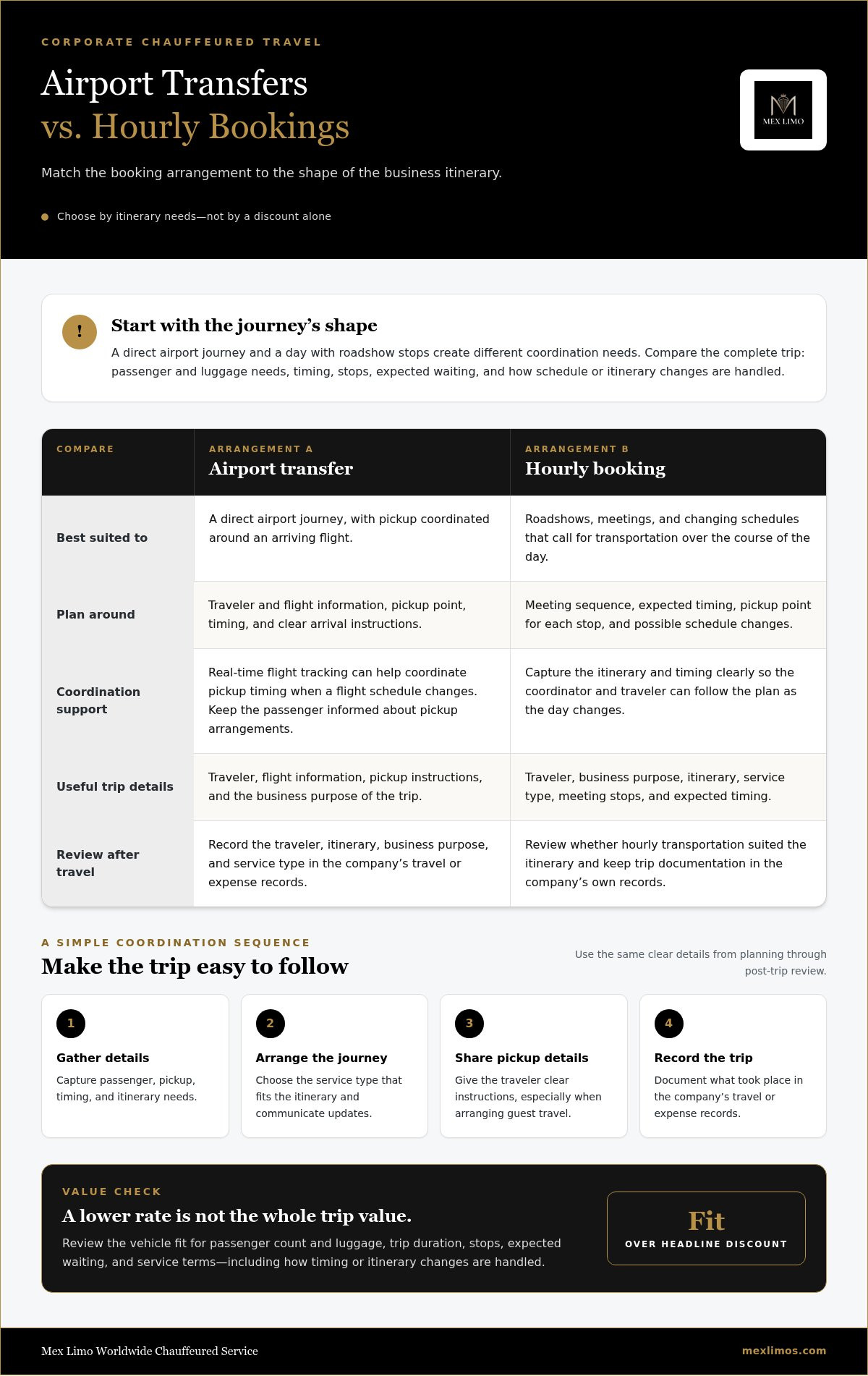
No. A stated discount describes a reduction against a quoted rate, but it doesn’t reveal the full value or fit of a completed journey. Compare the whole itinerary: the vehicle suited to the passenger count and luggage, trip duration, number of stops, expected waiting, and the service terms that apply. A lower rate may not suit a multi-stop schedule as well as an arrangement designed around the day’s travel needs.
Review each journey on consistent terms, including what the quoted service covers and how changes to timing or itinerary are handled. This makes it easier to distinguish a useful corporate car service account from a discount that doesn’t address coordination or service consistency. The right measure is whether the arrangement fits how your people actually travel.
How corporate car service accounts can simplify bookings and oversight
A reliable process makes each trip easier to follow, from the initial itinerary through pickup and post-trip review. The coordinator gathers the travel details, arranges the journey, shares clear pickup information with the traveler, and records what took place afterward. Repeatable steps help prevent details from getting lost when schedules shift or several people are arranging transportation.
For airport journeys, real-time flight tracking can help coordinate pickup timing when a flight schedule changes. It gives the transportation team useful context for the arrival, while the coordinator can keep the passenger informed. Tracking supports coordination, but clear communication about pickup arrangements still matters.
What should a corporate booking process make easier?
A practical process should make it straightforward to arrange advance reservations, communicate schedule updates, and capture essential passenger and itinerary details. For a direct airport transfer, record the traveler, flight information, and pickup instructions. A multi-stop day may require the sequence of meetings, expected timing, and pickup point for each stop.
Employee travel and guest travel have different communication needs. Employees may already know the company’s pickup routine, while a business guest may need especially clear arrival and meeting instructions. A concise trip confirmation helps coordinators and passengers understand the plan and reduces uncertainty.
How can businesses review trip activity responsibly?
After a completed journey, record its business purpose, itinerary, traveler, and service type in the company’s own travel or expense records. These details can help coordinators spot recurring travel patterns, understand whether a transfer or hourly booking suited the itinerary, and keep trip documentation useful for internal review.
Transportation arrangements support the journey, while a company’s expense tools and internal records support its reporting. Keep those roles distinct: document trip details in the systems your business uses, then review them to understand travel activity and identify recurring needs.
Clear trip records turn individual journeys into travel activity that businesses can understand and oversee. For business itineraries that call for airport transfers or hourly transportation, explore corporate chauffeured travel as part of a considered booking plan.
Corporate account versus individual bookings: compare value, flexibility, and service
A recurring arrangement and a trip-by-trip reservation can both support professional business travel. The better fit depends on how often people travel, how complex their itineraries are, and how much coordination each journey requires. A discount alone doesn’t settle the question. Compare whether the booking approach fits your travel pattern and service needs.
| Factor | Recurring corporate arrangement | Individual bookings |
|---|---|---|
| Booking frequency | May suit regular executive journeys or repeated airport transfers. | May suit occasional, one-off trips. |
| Itinerary complexity | Can provide a consistent planning approach for roadshows and multi-stop days. | Can work well for a straightforward point-to-point journey. |
| Administration | May help coordinators repeat a familiar process across recurring travel. | Requires arranging each trip separately, which may be manageable at low volumes. |
| Flexibility | Useful when a repeatable structure helps manage changing schedules, subject to booking terms. | Lets each trip be arranged around its specific requirements, subject to booking terms. |
| Service needs | May align with ongoing executive, employee, or guest transportation needs. | May fit an occasional journey with limited coordination. |
When might a recurring corporate arrangement make sense?
Consider a structured approach if executives travel on a regular schedule, teams repeatedly need airport transfers, or a roadshow involves several stops in one day. A consistent planning method can reduce repeated coordination and help align each journey with the right vehicle and service type. It doesn’t guarantee lower costs. If schedules change often, assess how updates are handled and whether the arrangement remains practical as itineraries evolve.
When can individual bookings remain the practical choice?
For a company with occasional trips, a simple itinerary, and few people involved in organizing travel, booking each journey individually may be more straightforward. It lets the coordinator tailor arrangements to each trip rather than maintain a recurring process. Review the booking terms and flexibility for changes, especially if meeting times or travel plans may shift.
The corporate car service account benefits are most relevant when recurring travel creates a genuine need for greater consistency and oversight. If journeys are infrequent or vary widely, individual reservations may be an equally considered choice. Compare coordination effort, itinerary fit, service expectations, and terms alongside any stated discount. No single arrangement is best for every company.
A corporate car service account evaluation checklist for business buyers
A useful evaluation starts with your actual journeys, not the discount language in a proposal. Map who travels, where each trip begins and ends, how schedules change, and what level of service passengers require. This gives you a fair basis for comparing arrangements and deciding which corporate car service account benefits matter to your organization.
Which travel patterns should buyers map first?
Review a representative period of business travel and note the differences between executive, employee, and guest journeys. An executive may need a direct airport transfer before a meeting; an employee may travel between several appointments; a visiting guest may need clear pickup instructions and a professional welcome. These examples reveal coordination needs and help you compare arrangements against actual travel, rather than assumptions about savings.
- List recurring journeys. Include airport transfers, executive meetings, roadshows, event transportation, and other regular business trips.
- Identify passengers and volume. Separate executive travel from employee and guest transportation, and estimate how many passengers typically travel together.
- Map itinerary complexity. Record direct transfers, multiple stops, expected trip duration, and how often timing or destinations change.
- Match vehicle categories to the trip. Consider passenger count, luggage, and whether a sedan, SUV, stretch limousine, or passenger van better suits the journey.
- Compare service formats and terms. Assess hourly bookings against per-trip travel, and review how itinerary changes, waiting, and pickup details are handled.
- Assess service requirements. Consider whether real-time flight tracking supports airport coordination and whether professional chauffeur service aligns with passenger expectations.
Which service and booking terms deserve close attention?
Compare complete itineraries on consistent terms, including vehicle suitability, journey duration, stops, waiting, and schedule variability. A direct airport transfer has different requirements from an hourly roadshow with several appointments. Look for clarity on how the booked service fits those needs, rather than treating a headline discount as proof of better overall value. Explore corporate chauffeured travel for business journeys shaped around airport transfers and multi-stop itineraries.
Flight monitoring can help coordinate airport pickups when schedules change, while professional chauffeurs contribute to a composed, courteous passenger experience. Weigh these service strengths against your company’s travel patterns, then compare the practical fit of each arrangement. The result should be a considered choice that supports travelers and coordinators, not a commitment based on one appealing feature.
How Mex Limo supports corporate chauffeured travel from booking to arrival
Corporate travel is rarely one-size-fits-all. A scheduled airport arrival, a day of back-to-back meetings, and transportation for a business event call for different planning. Mex Limo provides corporate chauffeured travel, airport transfers, hourly bookings, and event transportation, with professional chauffeurs and a fleet that includes sedans, SUVs, and stretch limousines. These services support business itineraries, from point-to-point transfers to multi-stop days.
Which Mex Limo services fit common business itineraries?
For a planned arrival or departure, an airport transfer gives the journey a clear purpose and schedule. Real-time flight tracking helps coordinate airport pickups if flight timing changes, while 24/7 availability supports travel plans across different hours. For a roadshow or a day with several appointments, an hourly booking can accommodate a multi-stop itinerary within one planned service period.
Choose a vehicle based on passenger and trip requirements. A sedan may suit an individual traveler, while an SUV or stretch limousine may better fit other passenger needs. Consider the itinerary, number of travelers, and luggage rather than appearance alone. Event transportation can also support business journeys connected with corporate gatherings.
What can businesses expect from a professional chauffeured journey?
A polished journey depends on more than reaching the destination. Professional chauffeurs bring courteous service and attention to pickup details, while punctuality matters when a traveler has a flight, meeting, or event to reach. For airport trips, real-time flight tracking provides useful context when arrival times shift and helps coordinate the pickup with the itinerary.
Businesses comparing vehicle categories can also read a guide to chauffeured luxury vehicles to consider how different options align with passenger and journey requirements.
The value of corporate car service account benefits ultimately depends on how well the transportation plan supports the journeys employees, executives, and guests actually take. Mex Limo brings airport transfers, hourly itineraries, and event travel together with professional chauffeured service. Explore Mex Limo corporate chauffeured transportation for a considered approach to business travel from booking to arrival.
Make your business travel plan more predictable
The strongest corporate car service account benefits come from more than a discount. Compare the full journey, including coordination, itinerary fit, vehicle needs, and service terms, then choose an arrangement that suits how often your team travels. Clear trip records can also help coordinators review activity and keep employee, executive, and guest journeys organized.
Mex Limo provides chauffeured transportation with professional chauffeurs and real-time flight tracking to support business and airport journeys. Airport transfers suit scheduled arrivals and departures, while hourly bookings can accommodate roadshows and multi-stop itineraries. These practical service options bring consistency and attentive hospitality to changing business schedules.
Ready to plan transportation around your company’s travel needs? Explore Mex Limo corporate chauffeured travel.
Frequently Asked Questions
What are the main benefits of a corporate car service account?
The main benefits are more organized travel planning, easier coordination, and a consistent service approach for recurring business journeys. The most useful corporate car service account benefits depend on your travel pattern: coordinators may find repeat journeys easier to arrange, while travelers benefit from professional chauffeur service and clear pickup details. Assess these practical advantages alongside rate terms rather than treating a discount as the sole measure of value.
Do corporate car service accounts always include discounts?
No, a corporate car service account doesn’t necessarily include a discount. Account arrangements vary, so assess the specific terms rather than assuming a reduced rate is part of the offer. Even without a discount, an organized approach may be valuable if it makes recurring trips easier to coordinate. Compare the complete journey, including vehicle suitability, trip duration, stops, waiting, and service terms, to understand the overall fit for your business.
Is a corporate car service account worth it for a small business?
It can be worthwhile if your small business regularly arranges airport transfers, executive travel, or multi-stop itineraries and wants a consistent way to manage those journeys. If travel is occasional and straightforward, booking each trip individually may be simpler. Consider who coordinates transportation, how often schedules change, and whether repeat travel creates enough administrative work to justify a structured arrangement. The best fit depends on your actual travel needs, not company size alone.
How does a corporate car service account differ from booking each trip individually?
A corporate car service account is an organized approach to recurring business journeys, while individual bookings are arranged separately for each trip. A recurring arrangement may help coordinators apply a familiar process to repeated travel, such as regular airport transfers. Individual reservations can suit occasional journeys with different requirements each time. Compare coordination effort, itinerary flexibility, service terms, and the needs of the traveler before choosing an approach.
Can a corporate car service handle airport transfers and multi-stop itineraries?
Yes. Mex Limo provides airport transfers for scheduled arrivals and departures, as well as hourly bookings suited to roadshows and multi-stop business itineraries. Professional chauffeurs support the passenger journey, and real-time flight tracking helps coordinate airport pickups when flight schedules change. Businesses can consider sedans, SUVs, or stretch limousines based on passenger and itinerary needs, rather than assuming one vehicle category is right for every trip.
What should a business compare before choosing a corporate car service?
Compare your travel patterns, passenger requirements, vehicle categories, and itinerary types, including airport transfers, hourly journeys, and multi-stop schedules. Review how timing changes and waiting are addressed in the service terms, and consider whether professional chauffeur service and flight tracking suit your travel needs. Look beyond headline discount language: the right arrangement should align with the complete journey and make transportation clearer for coordinators and passengers.