
A smooth executive journey often depends on decisions made before the ride begins. A proposal for executive transportation service should turn your team’s travel patterns into a clear plan, not just list vehicles and routes. When the request is vague, even a polished proposal can leave the scope, booking approach, and costs unclear.
Decision-makers need enough detail to compare options and approve a plan. Executives, meanwhile, expect punctuality, discretion, and professional care. A useful proposal connects both priorities to the journeys your team takes, from direct airport transfers to hourly transportation between meetings.
This guide covers what to include in your request, how to assess a proposal’s fit, and which details help clarify the service before booking. It also explains how to match vehicle categories to passenger needs and itineraries, and how professional chauffeurs and real-time flight tracking support airport and corporate travel.
Key Takeaways
- Build your travel brief around recurring journeys, passenger counts, and schedule patterns so the service scope reflects actual needs.
- A strong proposal for executive transportation service should distinguish direct airport transfers from hourly bookings and explain what each covers.
- Compare proposals using practical criteria such as itinerary coverage, vehicle category, and coordination for multi-stop travel or schedule changes.
- Match the vehicle category to the passenger group and itinerary, whether the journey calls for a sedan, SUV, stretch limousine, or passenger van.
- Mex Limo’s corporate travel, airport transfer, and hourly options can support different executive travel requirements.
Why an Executive Transportation Service Proposal Should Start with the Travel Requirement
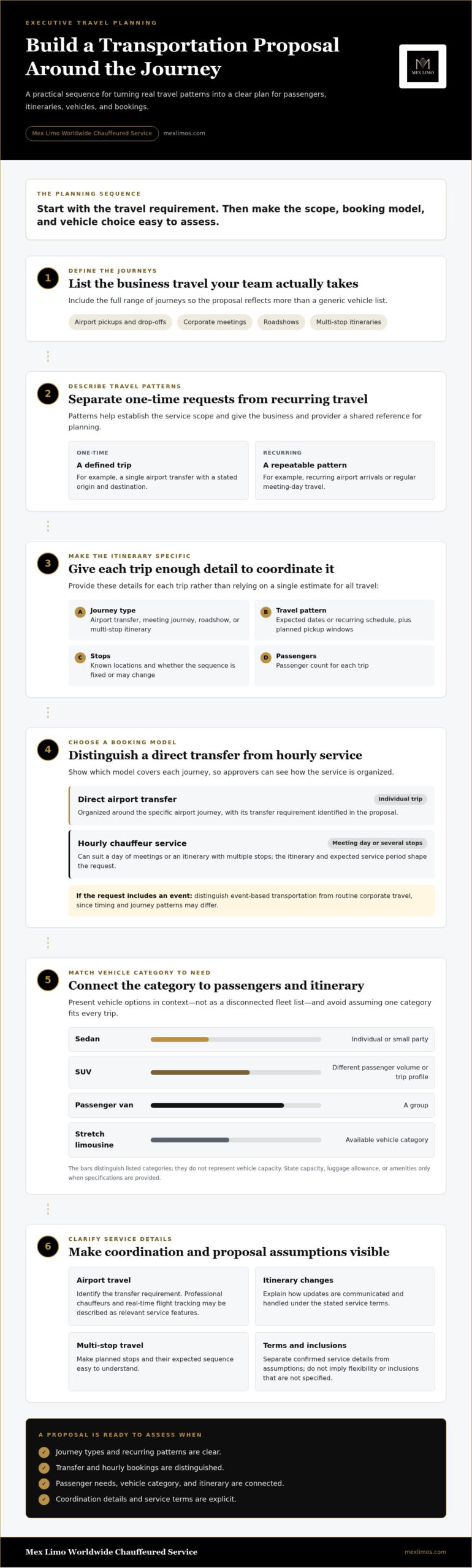
A polished vehicle is only one part of executive transportation. Before comparing options, outline the journeys employees take, the transportation required, and the booking approach that fits each trip. A proposal based on actual travel needs gives your business and transportation provider a shared reference for planning.
A useful proposal is a travel plan shaped around real passenger patterns, not a generic list of vehicles and services. That matters when a missed connection, tightly scheduled meeting, or itinerary change could affect the rest of an executive’s day. Clear expectations support coordination, discretion, and a professional passenger experience. The Chauffeur overview provides background on the professional role; in an executive setting, courtesy and a composed manner are part of the journey, not an afterthought.
Which executive travel situations belong in the brief?
Include the full range of business journeys, from airport pickups and drop-offs to corporate meetings, roadshows, and itineraries with several stops. Separate one-time requests from recurring travel. A single airport transfer has a defined origin and destination, while recurring airport arrivals may call for a repeatable transfer arrangement. A day of meetings at multiple locations may be better suited to an hourly booking, where the itinerary and expected service period shape the request.
Describe typical passenger counts, how often journeys occur, pickup and arrival windows, and whether stops are fixed or may change. For example, distinguish an individual executive’s occasional airport travel from a team’s recurring meeting-day itinerary. These patterns help define the service scope while leaving the vehicle category open until passenger and itinerary needs are clear.
What should a proposal help decision-makers understand?
A clear proposal shows which journey types are covered, whether bookings are organized as direct transfers or hourly service, and how the proposed arrangement fits the schedule. For a multi-stop itinerary, the planned stops and expected sequence should be easy to understand. For airport travel, the proposal should identify the transfer requirement so the trip can be organized around it.
Vehicle categories should also make sense in context. A sedan may suit an individual or small party, while an SUV or passenger van may better fit different passenger volumes or itinerary needs. The proposal should explain the category being considered without assuming one option suits every trip. Where relevant, it can describe professional chauffeurs and real-time flight tracking for airport transfers as service features, without promising a particular outcome.
This level of detail helps approvers determine whether a plan reflects their travel needs. They can then review the proposed journey scope, booking organization, and passenger requirements before making a decision.
What to Include in an Executive Transportation Service Proposal
A useful proposal makes the service easy to picture before booking. It connects the requested journeys to a booking model, passenger needs, vehicle category, and communication approach. Without those details, decision-makers may see a list of options but still lack the information needed to judge whether the plan fits their team.
A clear proposal connects trip scope, vehicle category, and booking model in one practical plan. For a proposal for executive transportation service, organize the details so an approver can see what is covered, how each journey is arranged, and what information is needed to coordinate it. Distinguish confirmed service details from assumptions, especially around booking terms and inclusions.
How should the itinerary and booking model be described?
Describe each journey type and how it will be booked. Airport transfers are arranged around individual trips, while hourly chauffeur service can suit a meeting day or an itinerary with several stops. Separate event-based transportation from routine corporate travel if the request includes a scheduled occasion, since its timing and journey pattern may differ from regular office or airport journeys.
For clarity, outline the details that shape coordination:
- Journey type, such as an airport transfer, meeting journey, roadshow, or multi-stop itinerary.
- Expected travel dates or recurring schedule patterns, along with planned pickup windows.
- Known stops and whether the itinerary is fixed or may change.
- Passenger count for each trip, rather than a single estimate for all travel.
This format distinguishes a one-time transfer from a recurring travel requirement, and a direct journey from a day that needs hourly service. If an itinerary changes, describe how updates are communicated and handled under the stated service terms. Avoid implying flexibility or inclusions that the proposal does not specify.
How should vehicle and service details be presented?
Relate vehicle categories to the itinerary and passenger needs instead of presenting them as a disconnected fleet list. A sedan may suit an individual executive’s transfer, an SUV may fit a different trip profile, and a passenger van can be considered for a group. A stretch limousine is another available category. State capacity, luggage allowances, or amenities only when those specifications are provided.
For airport journeys, describe professional chauffeurs and real-time flight tracking as relevant service features. The proposal should also state booking requirements and applicable service terms accurately, including the information the client needs to provide to arrange each trip. Naming a booking contact and explaining how itinerary updates are shared can clarify communication expectations without promising outcomes.
For teams considering corporate chauffeured travel, this structure makes it easier to relate airport transfer and hourly booking options to the journeys at hand, then compare vehicle categories with the actual itinerary.
How to Assess an Executive Transportation Proposal for Operational Fit
An elegant presentation may make a proposal appealing, but it does not show whether the service fits your team’s day-to-day travel. Focus on operational clarity: can decision-makers see which journeys are covered, how each is booked, and what details shape coordination? If the scope is vague, polished language and a broad vehicle list still leave practical questions unanswered.
Use the same criteria to review each option. A proposal for executive transportation service should let you compare the requested itinerary with the service described, without requiring approvers to infer what a general claim means.
Which proposal details make service scope easier to assess?
Review each journey type separately. An airport transfer, meeting-day itinerary, and recurring travel pattern may call for different booking approaches. Check that each description identifies the booking model, vehicle category, passenger needs, and coordination details. If an element is unclear, note it as an unresolved point rather than treating it as an included service.
Itinerary coverage: Does the proposal describe the trips, stops, and schedule patterns in your brief?
Booking model: Are direct airport transfers distinguished from hourly bookings for meetings or multi-stop travel?
Vehicle category: Does the proposed sedan, SUV, stretch limousine, or passenger van align with the stated passenger needs and itinerary?
Coordination: Does the description explain how trip information and itinerary changes are communicated, without relying on assumed inclusions?
These criteria make comparisons more precise. If a business itinerary includes several scheduled meetings, for example, an hourly booking may fit more naturally than treating each leg as an isolated transfer. The goal is not to assume one model is always better, but to see whether the proposal reflects the actual travel pattern.
How can businesses assess flexibility and coordination?
Look for a clear description of how the proposed service relates to schedule changes and multi-stop requirements. For an airport journey, real-time flight tracking is a relevant coordination feature. It supports trip planning, but it is not a guarantee of a particular arrival time or outcome. For hourly travel, the itinerary should make the expected sequence of stops understandable.
Before approving a proposal, compare its assumptions with the information your team can provide at booking. Clear inputs help the service plan reflect the journey rather than an incomplete outline.
- Passenger count for each journey, including differences between trips.
- Pickup and destination details, planned stops, and expected schedule.
- Whether travel is one-time, recurring, airport-based, or hourly.
- Known itinerary changes and the communication contact for updates.
Broad claims such as “seamless service” or “complete flexibility” are less useful than an explicit description of scope and coordination. A well-defined proposal shows what the plan covers, how it corresponds to the itinerary, and which details the business must communicate for accurate booking.
How to Prepare a Clear Request for Executive Transportation
A concise request gives a transportation provider the information needed to shape a proposal around your team’s actual travel. Start with a short travel audit, group findings by journey type and pattern, then indicate which booking model appears to suit each itinerary. You do not need to prescribe every service detail; make the requirements clear enough to evaluate.
Use this sequence to prepare a practical brief:
- Review travel patterns. Gather recent or expected business journeys and group them by purpose and frequency.
- Record itinerary details. Note travel dates, pickup timing, destinations, planned stops, and passenger counts for each trip.
- Separate journey types. Distinguish airport transfers from meetings, roadshows, and scheduled event transportation.
- Indicate the service model. Identify trips that appear suited to per-trip airport transfers and itineraries that may call for hourly booking.
- Flag relevant passenger needs. Include accessibility requirements and scheduling preferences that affect the plan.
What information should a business gather first?
For recurring travel, describe the pattern rather than listing every possible date. For example, note that an executive regularly needs airport transportation, then provide typical timing and destinations. For a roadshow, outline the planned stops and schedule. Keep event transportation distinct from routine corporate journeys so the proposal can reflect the occasion’s itinerary.
Record passenger counts for each trip. A group traveling together may have different vehicle needs from an individual executive, so avoid combining distinct journeys into one average. Include accessibility needs or scheduling preferences where relevant, and separate confirmed details from estimates. This keeps the brief useful without presenting assumptions as requirements.
How should the request translate into a practical service plan?
Relate the booking approach to the shape of the itinerary. A direct airport journey may suit per-trip service, while meetings or several stops may be better described for hourly booking. Then connect passenger requirements to a vehicle category such as a sedan, SUV, stretch limousine, or passenger van. Focus on the categories and features your team actually needs.
A helpful brief is specific about the journey and restrained about the solution. State what is known, mark what remains an estimate, and avoid assuming amenities or booking terms that have not been requested. For further context on planning executive mobility, explore this guide to corporate chauffeured travel.
Once your travel patterns are organized, explore corporate transportation options that can inform the service model for your request. A well-prepared brief makes the resulting proposal easier to assess because its itinerary, passenger needs, and booking approach are clear from the outset.
What Mex Limo Brings to an Executive Transportation Proposal
An executive transportation plan should reflect the way your team travels, whether that means a direct airport journey, recurring corporate travel, or a day of meetings with several stops. Mex Limo Worldwide Chauffeured Service provides chauffeured transportation, with service options that can be matched to the itinerary rather than treated as interchangeable bookings. A well-prepared request helps connect your needs to an appropriate service model and vehicle category.
For a proposal for executive transportation service, the value lies in matching trip requirements to the transportation being planned. Mex Limo Worldwide Chauffeured Service’s professional chauffeurs support a polished passenger experience, and real-time flight tracking is included with airport transfer service. These features support trip coordination without promising a particular outcome.
Which Mex Limo Worldwide Chauffeured Service offerings can support executive itineraries?
Airport transfers suit direct journeys to or from an airport. Hourly bookings can support a dedicated itinerary, such as a meeting schedule with multiple stops, while corporate chauffeured travel addresses business transportation needs more broadly. Separating these models in a request helps clarify whether each journey is a point-to-point transfer or requires service over a planned period.
Consider vehicle categories in relation to passenger count and trip structure. A luxury sedan may suit an individual executive’s journey, while an SUV or passenger van may better fit other group or itinerary requirements. A stretch limousine can be relevant when the brief or occasion calls for that style of travel. Mex Limo Worldwide Chauffeured Service’s vehicle options include sedans, SUVs, stretch limousines, and passenger vans. The right category depends on the requirements of each trip.
To make the service plan more useful, group journeys by purpose and share the details that influence coordination:
- Airport transfers, including relevant flight information for the journey.
- Hourly itineraries, with expected timing and planned stops.
- Corporate travel patterns, including passenger needs and trip frequency.
- Any occasion-specific transportation where a distinct vehicle category is requested.
What are the next steps toward a tailored service plan?
Before reaching out, organize the schedule, passenger requirements, destinations, and journey types in one concise brief. Distinguish confirmed details from estimates, and identify which trips are direct airport transfers versus hourly itineraries. This gives the discussion a practical starting point and keeps the proposed scope connected to real travel needs.
If you’re comparing vehicle categories for an itinerary, the guide to chauffeured luxury vehicles offers additional fleet context. With your travel requirements prepared, discuss an executive transportation plan with Mex Limo Worldwide Chauffeured Service and outline the airport, corporate, or hourly service needs you’d like to address.
Make Your Next Executive Travel Plan More Intentional
Treat transportation planning as part of your team’s wider travel process, not a one-time purchasing decision. Keep a concise record of what works, where itineraries tend to change, and which booking approach suits different types of business travel. That reference can help your organization make future requests more consistent as schedules and passenger needs evolve.
A well-prepared proposal for executive transportation service gives decision-makers a practical foundation for matching travel requirements with a considered plan. Once your priorities are clear, you can move from comparing details to arranging service around the journeys your team needs to make.
Begin planning executive transportation with Mex Limo and take the next step toward a more organized travel plan.
Frequently Asked Questions
What should an executive transportation service proposal include?
It should make the proposed service easy to compare with your company’s travel requirements. Look for a defined scope, the booking approach for each journey, relevant vehicle categories, and clear service terms. For example, a proposal covering an executive’s airport trip and a separate team meeting day should distinguish those requests rather than treating them as one generic service. Note any details that need clarification before approval.
How do I request a proposal for executive transportation service?
Prepare a concise request describing the travel you need covered, then share it with the transportation provider. Include likely dates, pickup and destination details, passenger counts, stops, and whether the journeys are recurring. Separate confirmed details from estimates, such as a meeting schedule that may still change. This gives the provider a practical basis for shaping a proposal without requiring you to decide every service detail in advance.
What is the difference between hourly chauffeur service and per-trip transportation?
Per-trip transportation is arranged around a specific journey, such as an airport transfer from one pickup point to a destination. Hourly chauffeur service provides a vehicle and driver for a booked period, which can suit a roadshow or a day with multiple meetings. The itinerary’s structure is a useful guide: a direct journey may suit per-trip service, while several planned stops may call for hourly booking.
Can an executive transportation proposal cover airport transfers and business meetings?
Yes. A proposal can address both airport transfers and transportation between business meetings when each need is described clearly. For instance, a request might include a direct airport journey on one date and hourly service for a later meeting schedule. Keeping the two itinerary types distinct helps decision-makers understand how each would be organized. Mex Limo offers airport transfers and corporate chauffeured travel for these business transportation needs.
How should a company choose the right vehicle category for executive travel?
Start with the passenger count and journey requirements, then consider the vehicle category that suits them. A sedan may be appropriate for an individual executive, while an SUV or passenger van may better fit other group or itinerary needs. A stretch limousine can suit a brief where the occasion calls for that style. Use current vehicle specifications rather than assumptions about capacity or amenities.
What information should I provide when requesting corporate transportation?
Share the information that affects the itinerary and coordination: travel dates, pickup timing, destinations, planned stops, passenger count, and whether the trip is one-time or recurring. For airport journeys, include flight details relevant to the transfer. If meeting times or passenger numbers are estimates, label them as such. Mention accessibility needs or scheduling preferences when they affect the travel plan, so these requirements are visible from the start.
Does a transportation proposal include real-time flight tracking for airport trips?
Mex Limo’s airport transfer service includes real-time flight tracking. For an airport-trip proposal, this feature can be included in the service description so decision-makers understand how flight information supports trip coordination. Tracking is a service feature, not a guarantee of a particular arrival time or outcome. Keep it distinct from hourly transportation for meetings, which follows a different booking model.